SEO and GEO: How Traditional Search Optimization and Generative Engine Optimization Work Together
SEO lays the foundation. GEO builds what comes next.
Understand exactly how traditional search optimization and generative engine optimization overlap, diverge, and reinforce each other.
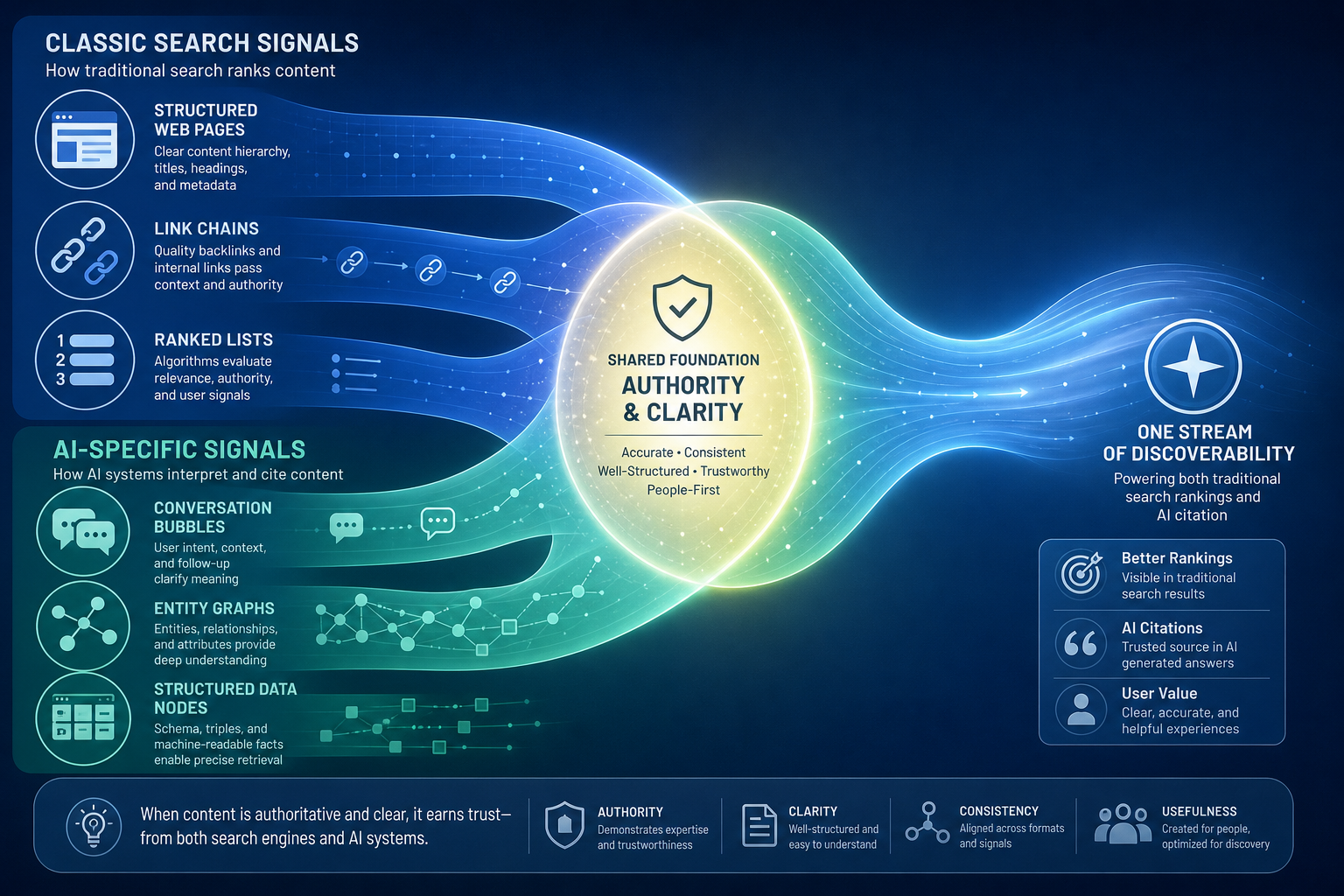
Map your path from search rankings to AI citations
Discover how SEO and GEO work together so you can optimize for both channels without starting from scratch.
What SEO does well and where it stops
Traditional SEO is built on a clear contract: produce authoritative, well-structured content that satisfies user intent, earn credible backlinks, keep your technical foundations clean, and Google rewards you with rankings. That contract has held for decades, and the fundamentals remain sound. Keyword targeting, page authority, and site architecture are still the bedrock of organic discovery.
The limitation is not that SEO stops working. It is that SEO is designed for a specific output: a ranked list of blue links. When a user types a query into Google and gets a page of results, SEO determines where your page sits on that list. What it was never built to do is influence whether an AI assistant, generating a direct conversational answer, decides to cite your business as part of that answer. That is a different mechanism entirely, and it requires a different layer of strategy on top of the SEO work you have already done.
Why AI engines cite content differently than Google ranks it
Generative engine optimization emerged as a discipline because AI-powered answer engines like ChatGPT, Perplexity, Google AI Overviews, and Claude do not rank pages the way Google does. They synthesize answers, and they pull from sources they judge to be clear, factual, and structurally easy to parse. The term GEO itself was introduced in a 2023 research paper later presented at KDD 2024, and the core finding was that GEO methods can lift visibility in generative engine responses by up to 40%.
The citation logic differs by platform. Perplexity is a citations-first engine that relies heavily on live web indexing, so it rewards recent content with clear dates and solid technical SEO health. ChatGPT leans more on semantic authority built up over time in training data. For real-time retrieval platforms, GEO changes can show results in days to weeks. For training-data-dependent platforms, the effect compounds over a longer horizon. Ranking on page one of Google does not guarantee you appear in any of these answers. The content needs to be structured the way AI agents prefer to consume it.
The concrete overlap between SEO and GEO practice
The good news for anyone with a solid SEO foundation is that the overlap is substantial. Both disciplines reward the same core signals: authoritative content, clear structure, credible sourcing, and genuine alignment with user intent. An AI engine interprets those signals through entity recognition rather than backlinks or click metrics, but the underlying content quality that earns SEO authority is the same quality that makes a page citation-worthy to an AI.
Where GEO adds specific requirements on top of SEO, they tend to be additive rather than contradictory. Question-style headings (H2s and H3s framed as the questions real buyers ask) help AI engines extract and cite your content directly. Schema markup makes your content machine-readable in a way that raises AI citation rates measurably. Promotional language, by contrast, actively reduces AI citation rates, which pushes GEO-optimized content toward the factual, direct register that also tends to perform well in organic search. You can read more about how AI is reshaping search optimization broadly to see how these forces are converging.
Running SEO and GEO as one unified strategy
Treating SEO and GEO as separate workstreams creates duplication and blind spots. The smarter approach is a unified content strategy that serves both channels from the same asset. A well-structured article that answers a specific buyer question clearly, uses schema markup, avoids promotional filler, and earns credible links is simultaneously a strong SEO asset and a strong GEO asset.
The practical additions GEO requires are modest: direct, factual phrasing over marketing language, comprehensive topic coverage that anticipates follow-up questions, and structured data that AI crawlers can parse. Google still processes around 14 billion searches per day, so organic rankings remain critical. But ChatGPT Search alone accounts for 87.4% of AI referral traffic to websites, and that share is growing. A strategy that ignores either channel is leaving a meaningful portion of buyer attention unaddressed. For businesses wanting to understand the specific mechanics of one major AI surface, the guide on Google AI Overviews and how to get featured in them is a useful companion read.
GEO does not replace SEO. It raises the ceiling on what good SEO content can achieve by making it visible in places Google rankings never reach.
Benefits
Broader reach across all discovery channels
A unified SEO and GEO strategy means your content is positioned to appear in traditional search result pages and in AI-generated answers simultaneously. Buyers who search on Google and buyers who ask ChatGPT or Perplexity can both find you, rather than only one group.
Compounding authority over time
Strong SEO signals, including credible backlinks and structured content, feed directly into the semantic authority that AI engines use to decide what to cite. The authority you build for Google compounds into AI citation potential, so the two channels reinforce rather than compete with each other.
Future-proofing your traffic sources
AI search is growing rapidly and is already reshaping how buyers discover businesses. Running GEO alongside SEO now means you are not dependent on a single channel. Diversifying across traditional and AI-driven discovery reduces the risk of a single algorithm change wiping out your visibility.
Efficiency gains from shared content assets
Content written to GEO standards, factual, clearly structured, and free of promotional filler, also performs well in organic search. One well-constructed page can serve both channels, eliminating the need to produce separate content sets for SEO and AI visibility.
Higher content quality as a side effect
GEO's requirement to avoid promotional language and prioritize direct, factual answers pushes content toward a register that readers and search engines both prefer. Research found that promotional language reduces AI citation rates by 26.19%, and that same language tends to underperform in organic search too.
SEO and GEO in practice: three scenarios
A local service business already ranking on Google
A physiotherapy clinic ranks consistently on the first page of Google for local search terms and gets steady organic traffic. But when a potential patient asks an AI assistant for a recommendation for a physio in their area, the clinic is not mentioned. The content on the site is written for keyword density rather than direct answers to patient questions. Adding question-style headings, structured data, and factual service descriptions allows the same pages to become citation candidates for AI engines without disrupting the existing SEO performance. This is a case where GEO is an additive layer, not a rebuild. Understanding how AI SEO tools can automate this layer is a practical next step.
A B2B company with strong long-form content
A software company has invested heavily in long-form blog content and ranks well for competitive industry terms. The content is detailed and well-sourced, which gives it a strong GEO foundation already. The gap is structural: articles are written in a narrative style without clear H2s framed as buyer questions, and schema markup is missing. Reformatting existing content with question-style subheadings and adding Article or FAQPage schema can meaningfully increase the likelihood that AI engines extract and cite those articles when buyers ask relevant questions during purchasing research. The schema markup validator guide covers exactly how to audit and fix this.
A marketing agency managing multiple client brands
An agency managing SEO for several clients begins seeing AI-generated answers displace traditional results for high-intent queries across multiple client categories. Reporting on rankings alone no longer captures the full picture of a client's search visibility. The agency needs to track citation positions across AI engines like ChatGPT, Perplexity, and Google AI Overviews alongside traditional rank data, and to produce GEO-optimized content at scale without doubling the content workload. Treating SEO and GEO as one unified workflow, with shared content assets and a single tracking system, is the only way to manage this efficiently across a portfolio of clients.
SEO and GEO: questions practitioners actually ask
Does GEO cannibalize my existing SEO traffic?
GEO does not take traffic away from your existing SEO performance. The two channels address different surfaces: SEO targets ranked results pages, while GEO targets AI-generated answers. A user who finds you via an AI citation is typically a different touchpoint in the discovery journey, not a redirect from organic traffic. In practice, content optimized for GEO tends to strengthen SEO performance as well, because the clarity and structure AI engines prefer also align with what Google rewards.
Do I need to rewrite my whole website to do GEO?
No. GEO optimization is largely additive. The most impactful changes, such as reformatting headings as questions, adding schema markup, and removing promotional filler, can be applied to existing pages without a full rewrite. Pages that already have strong SEO fundamentals (clear structure, credible content, good technical health) have a significant head start for GEO. The work is more about layering specific formatting and structured data onto what you already have than rebuilding from scratch.
How do I measure my visibility in AI search results?
Traditional rank trackers do not capture AI citations, so you need a tool that monitors your brand's presence across AI engines like ChatGPT, Perplexity, Google AI Overviews, and Claude directly. Tracking citation position across multiple AI engines in real time is a distinct measurement task from monitoring Google rankings. Miracly's AI search rank tracker is built specifically for this, monitoring where and how often your business is cited across AI platforms.
Is GEO relevant if I'm already ranking well on Google?
Yes, because ranking on Google does not translate automatically into AI citations. The research is clear that strong SEO gives you a head start, but AI engines use different signals (entity recognition, factual clarity, structured data) rather than simply mirroring search rankings. A business that ranks well on Google but has not optimized for GEO is invisible to buyers who use AI assistants for the same queries. Given that ChatGPT Search alone accounts for 87.4% of AI referral traffic, that is a significant gap.
Can small businesses realistically do both SEO and GEO?
Yes, particularly because the two disciplines share so much common ground. A small business that produces clear, factual, well-structured content is already doing the foundational work for both. The GEO-specific additions, question-style headings, schema markup, and factual rather than promotional language, are not expensive or technically complex. The main challenge is consistency and scale: producing enough content, keeping it current, and tracking performance across multiple AI engines. Platforms built for this task can handle the ongoing production and monitoring automatically.
Your SEO work is the starting point. GEO takes it further.
If your content is already earning Google rankings, you have more of the GEO foundation in place than you might think. The next step is understanding exactly where the gaps are and what it would take to close them across ChatGPT, Perplexity, Google AI Overviews, and beyond. Miracly analyzes your site, identifies the high-intent questions AI engines are answering in your category, and builds the structured content needed to get your business cited.