Semrush AI Visibility Toolkit vs. Miracly: Which Is Right for You?
Two tools, one goal: pick the right path to AI visibility
Semrush AI Visibility Toolkit tracks where you stand. Miracly builds the content that gets you there. Here is how to choose.
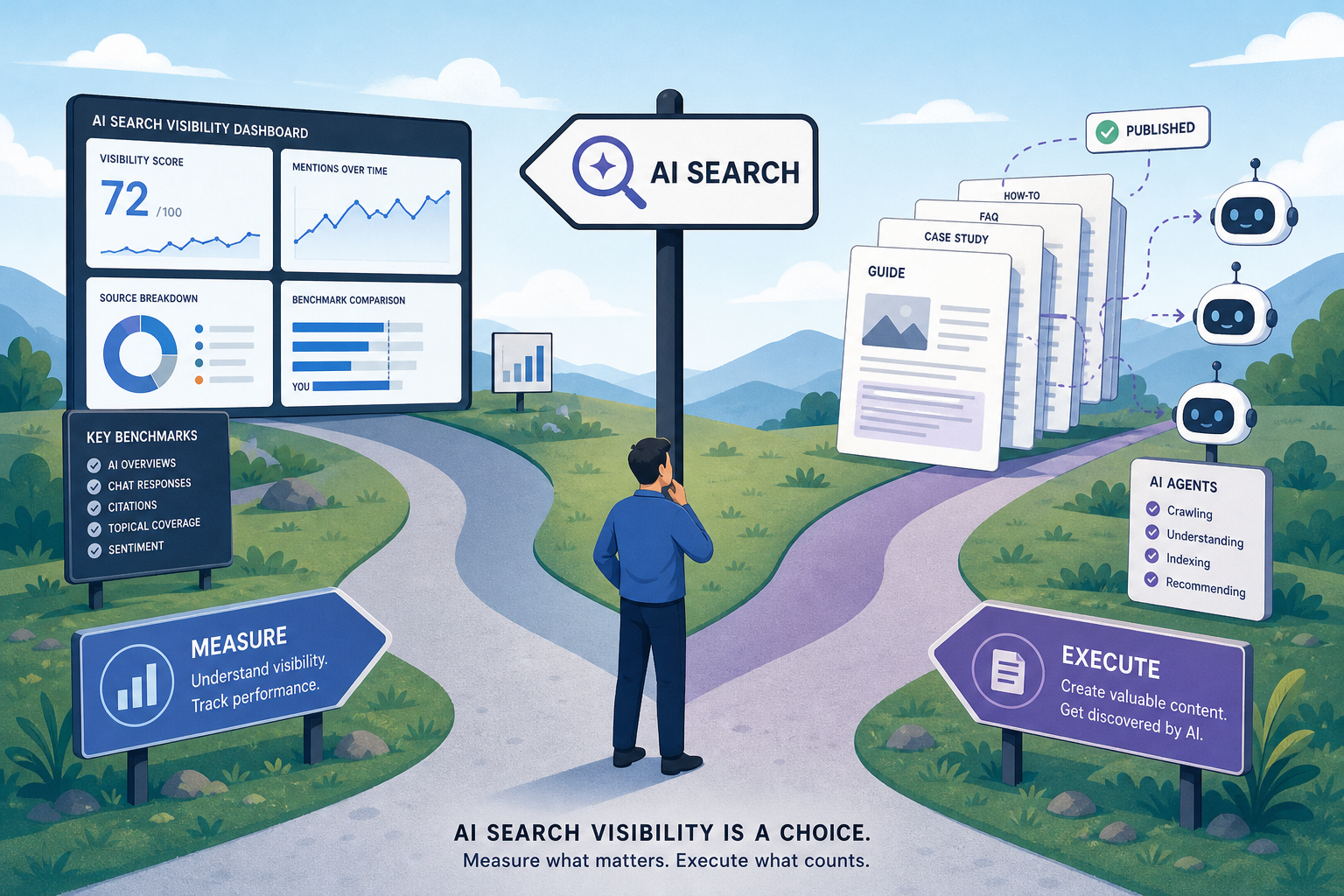
Semrush AI Visibility Toolkit vs. Miracly: find your fit
Find which tool fits your situation and start building real AI search visibility today.
AI search is changing who gets found and who gets skipped
Buyers are increasingly turning to ChatGPT, Perplexity, Google AI Overviews, and Gemini to answer purchasing questions before they ever click a link. When an AI assistant recommends a product, a service provider, or a brand, the businesses that appear in that answer capture attention that would previously have gone to the top ten blue links. The businesses that do not appear are simply absent from the conversation.
This shift is not gradual. Marketing teams that built their entire acquisition model around organic Google rankings are now watching traffic patterns change faster than their content calendars can respond. Understanding which tool helps you respond to that shift, and how, is exactly what this comparison is for.
What Semrush AI Visibility Toolkit actually does
Semrush's AI Visibility Toolkit is an analytics and measurement layer built on top of the existing Semrush platform. Its core job is to tell you how your brand is performing inside AI-generated answers right now. The toolkit is built around six distinct reports: a Visibility Overview showing how often your brand appears, a Competitor Research module that auto-identifies rival brands, a Prompt Research tool that functions like keyword research for AI queries, a Brand Performance report covering share of voice and sentiment, Prompt Tracking with daily updates, and an AI Search Site Audit that flags technical blockers stopping AI crawlers from reading your site.
The platform tracks AI engines including ChatGPT, Google AI Overviews, Google AI Mode, and Gemini, with Perplexity also listed in documentation. It measures both linked citations and unlinked brand mentions, giving SEO professionals a benchmark score and a gap analysis against competitors. For teams already inside the Semrush ecosystem, this integration is genuinely valuable: SEO and AI visibility data sit in one place, removing the need to reconcile reports from separate tools.
The toolkit is an add-on to Semrush's core plans, with daily prompt tracking capacity ranging from 25 prompts on the base tier to 200 on Semrush One Advanced. It is a strong fit for teams whose primary need is measurement and competitive benchmarking.
Where the Semrush toolkit stops and Miracly begins
The Semrush AI Visibility Toolkit is, by design, an analytics product. It tells you what is happening, identifies which prompts you are missing from, and surfaces the content gaps your strategy needs to address. What it does not do is close those gaps for you. Acting on the data still requires a separate content production workflow: a writer, a content brief, a publishing process, and a way to structure that content so AI agents can actually consume and cite it.
Miracly is built around exactly that execution step. It researches the high-intent questions buyers are asking AI assistants, automatically generates structured content pages engineered to be cited by AI agents, and publishes them alongside a client's existing website without touching it. The pages are formatted the way AI agents prefer to consume information, complete with schema markup, internal linking, and sitemap generation built in. Rather than producing a report that tells you what to do, Miracly runs as an ongoing content engine that does it.
This is not a weakness in Semrush's toolkit; it is a deliberate product scope. Semrush is an analytics and SEO research platform. Miracly is a generative engine optimization execution system. The two tools answer different questions.
Multi-engine coverage, languages, and real-time tracking
Both platforms track AI engine performance, but their approaches differ in scope and emphasis. Semrush tracks ChatGPT, Google AI Overviews, Google AI Mode, and Gemini, with Perplexity listed in documentation. Coverage depth across engines varies, and the prompt tracking capacity is tied to the plan tier a user is on.
Miracly tracks a business's citation and recommendation position in real time across multiple AI engines and markets, including ChatGPT, Claude, Google AI Search, Perplexity, and Gemini. It also offers content publishing in over 40 languages, which matters directly for businesses targeting audiences outside a single English-language market. A Semrush user working across multiple international markets would need to manage separate prompt sets and reporting views for each; Miracly's multilingual content generation addresses that need at the production level, not just the measurement level.
For teams that need to act globally and track results simultaneously, the combination of automated multilingual content and multi-engine tracking in one platform is a meaningful operational difference.
Choosing between analytics-first and content-engine-first
The honest summary is this: if your team already has strong content production capacity and needs better data to direct it, Semrush's AI Visibility Toolkit is a well-built, deeply integrated measurement tool. It slots into an existing Semrush workflow and gives SEO professionals the benchmarking data they need to prioritise where to focus.
If your team needs the content itself to be researched, written, structured, and published automatically, and you want to track your position in AI answers without managing a separate analytics stack, Miracly is the more complete operational fit. It is particularly well suited to businesses that lack a dedicated content team, to agencies managing AI visibility for multiple clients from a single dashboard with unlimited seats, and to brands targeting multilingual audiences who cannot afford to produce optimised content manually in each market.
Both tools are legitimate responses to the same underlying shift. The right choice depends on where your bottleneck actually sits: in knowing what to do, or in having the system to do it.
Semrush AI Visibility Toolkit vs. Miracly: which fits your need
Both tools address AI search visibility, but from opposite ends of the problem.
Choose Semrush AI Visibility Toolkit if you are an SEO-mature team that needs deep benchmarking data integrated with your existing Semrush workflow. Choose Miracly if your primary need is producing and publishing the structured content that earns AI citations, especially across multiple languages or client accounts.
Benefits
Content generation, not just gap reports
Miracly does not stop at identifying which AI prompts your brand is missing from. It automatically researches, writes, and publishes structured content pages designed to be cited by AI agents, closing the gap between knowing the problem and solving it.
Real-time tracking across five AI engines
Miracly tracks citation and recommendation position across ChatGPT, Claude, Google AI Search, Perplexity, and Gemini simultaneously. Monitoring multiple engines in one dashboard removes the need to reconcile data from separate tools or manually query each platform.
Publishing in over 40 languages
For businesses targeting international audiences, Miracly generates and publishes AI-optimised content pages in more than 40 languages. Multilingual content production at this scale is not achievable through manual workflows for most small and mid-sized businesses.
Unlimited seats for teams and agencies
Miracly's dashboard supports unlimited seats, meaning every team member or client contact can access the platform without triggering additional user fees. This makes it operationally practical for agencies managing multiple brands from a single account.
No disruption to the existing website
Miracly publishes AI-optimised content pages alongside a client's existing site without altering it. Teams do not need to involve developers or restructure their CMS. The existing website remains untouched while the new content layer is built and maintained automatically.
Four buyer profiles: which tool fits which situation
Local service business with no content team
A physiotherapy clinic or local accountancy practice is losing new patient and client inquiries as buyers shift from Google searches to asking AI assistants for recommendations. The business has no in-house writer and no SEO resource. Semrush's toolkit would surface the gap clearly, but acting on it would require hiring someone to produce and structure the content. Miracly's automated content generation and publishing addresses the execution problem directly, creating structured pages that AI agents can cite without requiring the business owner to manage a content workflow.
B2B company whose buyers research with AI
A B2B software company finds that procurement teams and decision-makers are using ChatGPT and Perplexity to shortlist vendors before ever visiting a website. The marketing team wants to understand its current share of voice in AI-generated answers and identify which competitor is being recommended instead. Semrush's Brand Performance and Competitor Research reports are genuinely well suited to this need: the team can benchmark daily, track sentiment, and build a data-driven content brief. If the team then needs to act on that brief at scale, Miracly's content engine becomes a natural complement.
Marketing agency managing multiple client accounts
An agency running AI visibility campaigns for several clients needs a single dashboard, scalable tracking, and the ability to produce optimised content without hiring a writer for each account. Semrush's toolkit is built around a per-domain model, and seat access is tied to the plan structure. Miracly's unlimited seats and multi-client content system make it operationally easier to manage a portfolio of brands from one place, with content being researched, written, and published automatically for each client. Agencies that already use Semrush for broader SEO reporting can keep it for that layer while using Miracly for AI content execution.
International e-commerce brand targeting multiple markets
An e-commerce brand selling across Europe and Southeast Asia needs AI-optimised content that works in French, German, Swedish, and Bahasa Indonesia, not just English. Semrush's prompt tracking and visibility reporting can cover multiple markets, but it does not generate the localised content those markets require. Miracly's 40-plus language publishing capability means the brand can have structured, AI-crawler-readable content pages produced and published in each target language as part of the same automated system, rather than commissioning separate translation and content projects for each market.
Semrush AI Visibility Toolkit vs. Miracly: common questions answered
Can I use Semrush AI Visibility Toolkit and Miracly together?
Yes, and for some teams this is a sensible approach. Semrush's toolkit provides detailed benchmarking data, competitor share of voice, and prompt gap analysis, while Miracly handles the content production and publishing that acts on those insights. A B2B marketing team with existing Semrush access could use the toolkit for strategic direction and Miracly as the execution engine, without the two platforms conflicting.
Does Miracly replace Semrush entirely?
Not for teams that rely on Semrush's broader SEO suite. Semrush covers backlink auditing, keyword research, technical site audits, and a range of other SEO functions that Miracly does not replicate. Miracly is purpose-built for AI search visibility: content generation, multi-engine tracking, and ongoing AI citation management. If a business's primary need is AI visibility rather than full-spectrum SEO, Miracly covers that ground as a standalone platform.
What if I already pay for Semrush? Is Miracly worth adding?
It depends on where your bottleneck is. If you are already getting strong insight from Semrush's AI Visibility Toolkit but struggling to produce the structured content that would improve your AI citations, Miracly addresses that execution gap directly. Automated content generation and multilingual publishing are capabilities the Semrush toolkit does not offer, so the two platforms are additive rather than redundant for teams that need both measurement and production.
How does pricing compare between the two tools?
Semrush's AI Visibility Toolkit is a paid add-on to an existing Semrush subscription, with prompt tracking capacity varying by tier. Miracly is a separate SaaS platform with its own pricing structure. Neither platform publishes a direct like-for-like comparison, so the right way to evaluate cost is to map each platform's scope against your actual needs: if you need content production at scale, a tracking-only tool will require additional budget elsewhere regardless of its headline price.
Which AI engines does each tool actually track?
Semrush's documentation lists ChatGPT, Google AI Overviews, Google AI Mode, Gemini, and Perplexity, though coverage depth varies by engine and plan tier. Miracly tracks citation and recommendation position across ChatGPT, Claude, Google AI Search, Perplexity, and Gemini in real time. Claude is notably present in Miracly's coverage and absent from Semrush's current documented engine list.
Is Miracly suitable for businesses that are not technically sophisticated?
Miracly is designed for businesses whose websites were built for human readers and are not structured for AI agents. The platform publishes AI-optimised content pages without touching the existing website, so no developer involvement or CMS restructuring is required. The built-in AI assistant, Mira, helps teams manage their content strategy from a single dashboard, making the platform accessible to non-technical users.
Ready to turn AI visibility insight into published, cited content
If your bottleneck is content production rather than measurement, Miracly is built for exactly that job. It researches the questions your buyers are asking AI assistants, generates structured pages engineered to be cited, and tracks your position across engines in real time. See how it works for your specific category and market.