What Is Google AI Mode and How Does It Affect Your Business Visibility?
Google AI Mode is reshaping search: what it means for your business visibility
Understand how AI-generated answers are replacing blue links, and what your business can do to stay cited and visible.
Find out if AI search can see your business
Check where your business stands before AI Mode erases your organic traffic.
What Google AI Mode actually is, and how it differs from standard search
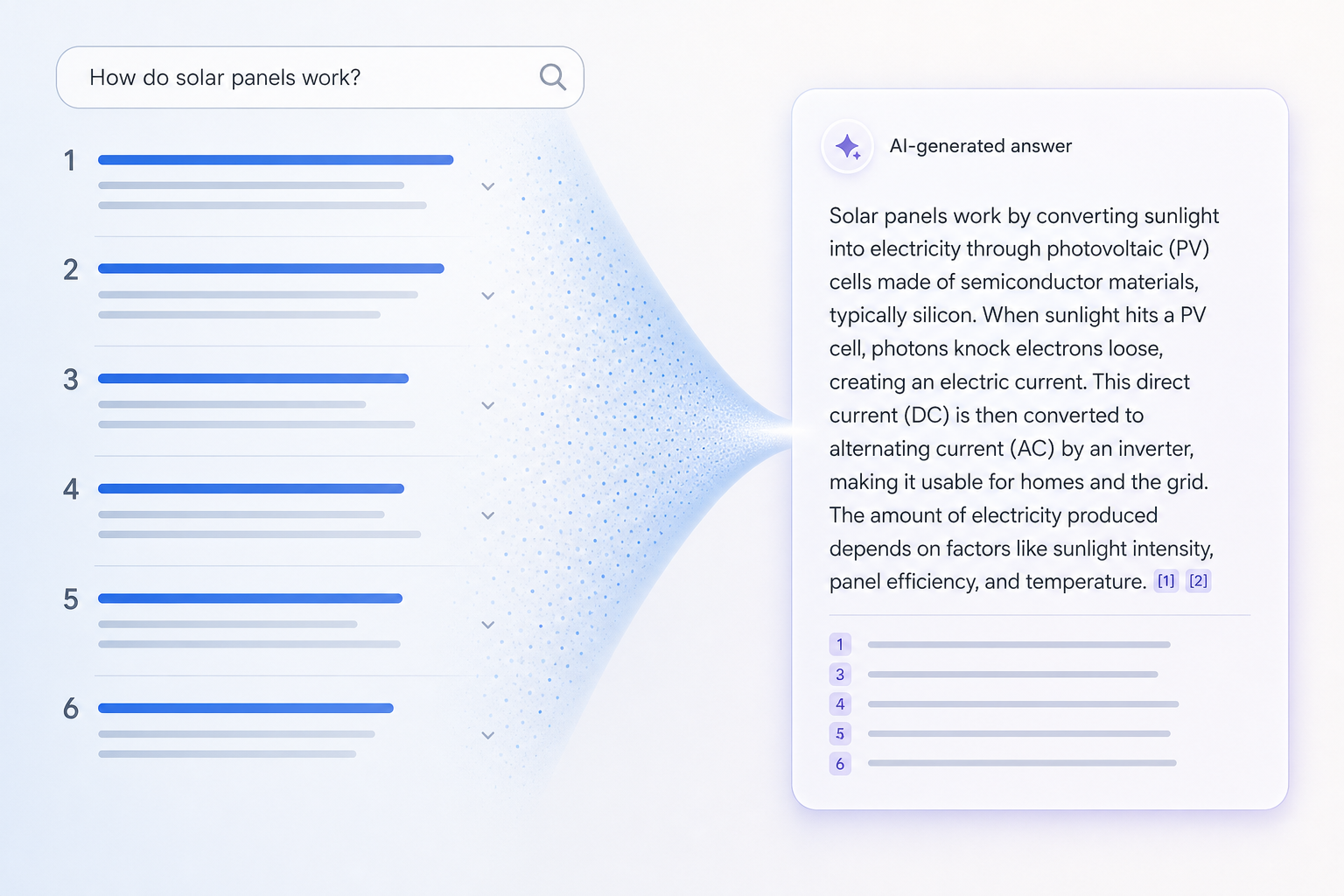
Google AI Mode is a separate, conversational search experience powered by Gemini, Google's large language model. Instead of returning a ranked list of blue links, it generates a synthesized written answer by breaking a query into smaller retrieval tasks, pulling evidence from across the web for each one, and combining the results into a single response with citations attached. This process uses Retrieval Augmented Generation (RAG), which means the model grounds its answers in live web content rather than relying solely on pre-trained knowledge.
It is worth distinguishing AI Mode from AI Overviews. AI Overviews appear automatically within standard search results as summary boxes above the organic listings. AI Mode, by contrast, is a fully interactive, conversational interface designed for deeper research, where users can ask follow-up questions and the system reasons through complex queries iteratively. Initially, AI Mode was available to Google One AI Premium subscribers in the United States, making it a premium, opt-in experience rather than a universal rollout at launch.
How AI Mode cuts click-through rates and what that costs your traffic
The most direct business consequence of AI Mode is that users get their answer on the results page and never visit your website. Studies found that over 90% of AI Mode searches end without a click to another website, and SparkToro's 2026 research found that 68% of all U.S. Google searches now end without any click to a website, up from 60% in 2024. When an AI Overview is present in standard search, that zero-click rate climbs to 83%.
The click-through data for ranked positions is equally stark. Organic CTR drops roughly 34% to 61% when an AI Overview appears, with position-one clicks down around 58% in some datasets. By Q4 2025, the cumulative decline in organic search clicks had reached 42% compared to pre-AI Overview baselines. Nearly half of the organic clicks that existed before AI systems were introduced are now gone. For businesses that built their customer acquisition on search traffic, this is not a future risk; it is a present reality.
Why being cited by AI is now a distinct visibility layer from ranking
There is a meaningful silver lining buried in the traffic data, and it changes how businesses should think about search strategy. Pages that are cited in AI Overviews receive 120% more organic clicks per impression than uncited pages on the same query, and Seer Interactive found a 35% traffic lift for brands cited in overviews versus those that were not. Critically, users who click through from an AI citation have already read a summary and are seeking deeper information; they convert 23% better than average organic visitors.
This means citation presence is a separate visibility layer from ranking. Citation overlap with the organic top 10 fell from roughly 76% in mid-2025 to between 17% and 54% in early 2026, so appearing in position one no longer guarantees you will be cited, and being cited does not require you to rank in the top ten. The question your business needs to answer is not just 'do we rank?' but 'does Google's AI trust our content enough to surface it as a source?'
What content signals help AI systems choose to cite your business
Google's AI systems tend to cite sources they can confidently summarize. That preference translates into concrete content signals. Topical authority matters more than keyword density: pages that cover a subject in genuine depth, answer follow-up questions, and demonstrate expertise are more likely to be selected as citation sources than thin pages optimized around a single phrase.
Structured data also plays a growing role. Schema markup helps AI crawlers understand the type, context, and relationships within your content, making it easier to extract accurate information. Clear, factual prose organized around specific questions aligns with how RAG systems retrieve and stitch together evidence. Content depth, internal linking that demonstrates breadth of coverage, and consistent factual accuracy across a site all contribute to the kind of trust signals that AI systems reward. Businesses that have historically published for human readers rather than structured for machine comprehension are now at a disadvantage, and closing that gap is the practical challenge Google AI Mode has created.
AI Mode vs. traditional search: key differences
Understanding where AI Mode sits relative to other Google surfaces helps businesses prioritize their optimization efforts.
Businesses need a strategy that addresses all three surfaces, since each has its own citation logic and each can independently determine whether your brand appears in the answer.
The question is no longer whether you rank, but whether AI trusts you enough to cite you.
Benefits
Protect traffic before it disappears
With over 90% of AI Mode searches ending without a click, businesses that optimize for AI citation now reduce their exposure to zero-click losses before they compound. Acting before your category competitors do preserves the organic traffic you have while others wait.
Earn the citation advantage
Pages cited in AI Overviews receive 120% more organic clicks per impression than uncited pages on the same query, and the visitors who arrive convert 23% better. Citation optimization is not just defensive; it actively improves the quality of your inbound traffic.
Build a competitive moat in your niche
AI systems favor sources with demonstrated topical authority. Publishing structured, in-depth content across the questions buyers ask in your category signals expertise that is difficult for competitors to replicate quickly, creating a durable visibility advantage.
Prepare your site for structured-data signals
Schema markup and well-organized content are increasingly important citation signals. Businesses that implement structured data now are better positioned as AI systems expand, because machine-readable content is the foundation every future AI search update will build on.
Cover multilingual and international AI queries
AI search is not limited to English-speaking markets. Businesses targeting multiple countries benefit from AI-optimized content in the languages their buyers actually use, ensuring citation visibility extends across markets rather than remaining concentrated in a single language.
How different businesses are affected by Google AI Mode
A local service provider losing foot traffic
A physiotherapy clinic that previously relied on Google searches like 'physio near me' or 'best physio for back pain' now finds that AI Mode generates a synthesized answer listing treatment approaches and general advice, without directing users to click through to any specific clinic's website. The clinic's position-one ranking no longer guarantees a visit, because the answer is delivered inline. To remain visible, the clinic needs content that answers the specific questions AI is synthesizing: what conditions are treated, what to expect at a first appointment, and what makes the clinic's approach distinctive enough to cite.
A B2B company whose buyers research via AI assistants
A software vendor selling project management tools to mid-market companies finds that prospective buyers are increasingly using AI assistants to research options before ever visiting a vendor website. The AI's synthesized comparison answer may mention competitors by name while omitting the vendor entirely, not because the vendor's product is inferior, but because its website lacks the structured, question-answering content that AI retrieval systems can confidently extract and cite. Publishing detailed pages around the specific questions buyers ask, such as integration capabilities, security standards, and pricing models, gives the AI system the material it needs to include the vendor in its answer.
A multi-market brand needing multilingual AI coverage
A retail brand operating across several European markets publishes its core content in English and relies on translation for secondary markets. As AI Mode expands, AI systems in each market pull from locally relevant, locally structured sources, meaning the brand's English-language authority does not automatically transfer to German, French, or Spanish AI answers. Without dedicated, well-structured content in each language, the brand is invisible in AI-generated answers for buyers in those markets, even if it ranks in traditional search. Multilingual AI-optimized content closes that gap.
Common questions about Google AI Mode and business visibility
Is Google AI Mode available everywhere, or only in certain markets?
At launch, Google AI Mode was available to Google One AI Premium subscribers in the United States. It is a separate, opt-in experience rather than a universal feature rolled out to all users globally. Availability is expected to expand over time, but businesses in markets outside the U.S. should monitor rollout announcements and begin optimizing content now rather than waiting for local availability.
Does AI Mode replace featured snippets and AI Overviews?
AI Mode and AI Overviews are distinct features. AI Overviews appear automatically within standard search results as summary boxes, while AI Mode is a separate, fully conversational interface users actively choose to enter. Featured snippets remain part of standard search. The practical implication is that businesses face multiple AI-driven surfaces simultaneously, each with its own citation logic, rather than a single feature replacing another.
Can small businesses realistically compete for AI citations against large brands?
Yes, because AI citation is driven by content relevance and topical authority rather than domain size alone. Citation overlap with the organic top ten has fallen significantly, meaning large brands that dominate traditional rankings are not automatically cited. A small business that publishes structured, in-depth content around the specific questions its buyers ask can earn citations in its niche even against larger competitors, provided the content is factually grounded and machine-readable.
How do you track whether your business is being cited in AI search results?
Tracking AI citations requires monitoring across multiple AI engines, since each system, including Google AI Overviews, ChatGPT, Perplexity, and others, sources its answers independently. Google Search Console integration provides some signal for AI Overviews within Google's ecosystem, but comprehensive tracking requires dedicated tools that query AI systems directly and record whether and how your brand is cited. Miracly's AI visibility tracker monitors citation position across multiple engines and markets in real time.
What is the single most important thing a business can do to improve AI Mode visibility?
Publish content that directly and thoroughly answers the specific questions your buyers ask, structured so that AI retrieval systems can extract and cite individual facts and claims. Topical depth, factual accuracy, and structured data are the signals AI systems use to select citation sources. A site full of broadly written, keyword-optimized pages is far less likely to be cited than one with focused, well-organized pages that treat each question as its own subject.
See how your business appears in AI search answers
Google AI Mode is already reshaping how buyers find businesses, and the citation gap between optimized and unoptimized content is widening. Miracly analyzes your website, identifies the questions your buyers are asking AI assistants, and generates structured content engineered to be cited. See where your business stands in AI search today.