AI search rank tracker
AI search rank tracker for every engine that matters
See exactly where your business appears in AI-generated answers, across ChatGPT, Gemini, Perplexity, Claude, and more.
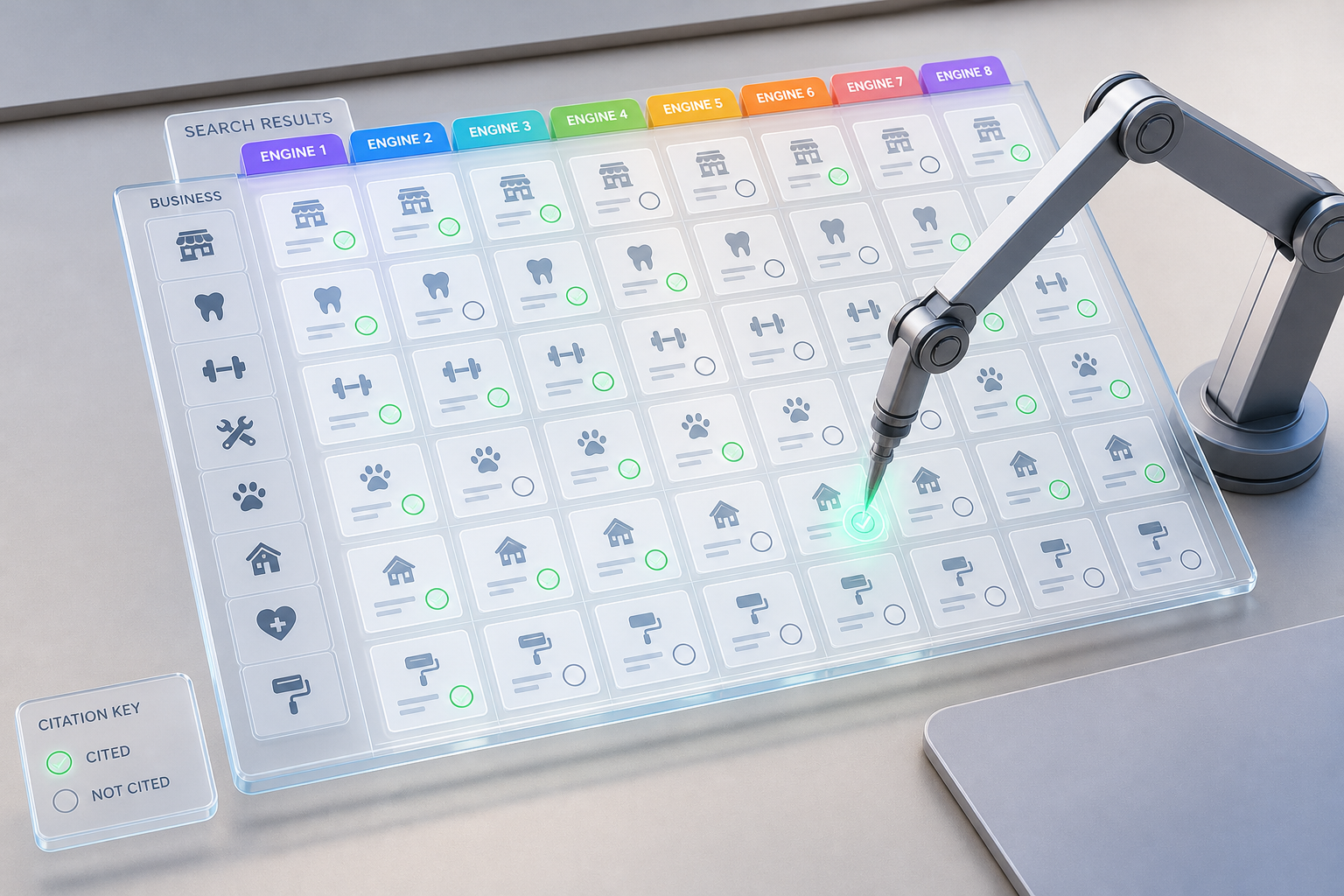
Find out where you rank in AI-generated answers
Track your position in AI answers across 8+ engines and find out which questions are already citing your competitors instead of you.
The blind spot every business has right now
Millions of buyers are getting their recommendations from AI assistants. They ask ChatGPT which accountant to use, ask Perplexity which physio clinic is best in their city, ask Gemini which B2B software fits their stack. The AI answers. Your business may be cited, or it may not. Until now, there has been no reliable way to know either way.
Traditional rank trackers measure your position on a Google results page. But AI-generated answers work differently: there is no page-one link list, no position 1 through 10. There is a paragraph of text, and either your brand is in it or it is not. That gap in visibility is the problem Miracly's AI search rank tracker is built to close.
What the tracker actually shows you
Miracly monitors your citation position across 8 AI engines: ChatGPT, Gemini, Google AI Search, Claude, Perplexity, Grok, Mistral, and DeepSeek. For each engine, it tracks the specific questions being asked, and shows whether your business is cited in the answer, how prominently, and how consistently over time.
This is question-level data, not aggregate scores. You can see that a particular buyer-intent query on Perplexity cites a competitor three times and never mentions you, or that your business is consistently recommended on ChatGPT for one service but invisible for another. That granularity is what makes the tracker actionable rather than decorative. The data refreshes in real time, so shifts in citation patterns surface quickly rather than weeks later.
Citation gaps become a content roadmap
Knowing where you are not cited is as valuable as knowing where you are. When the tracker surfaces a cluster of high-intent questions where competitors are being recommended and you are not, that is a direct signal about which content to prioritise next.
Miracly connects this data to its content generation system, so citation gaps translate directly into new structured pages designed to be understood and cited by the AI engines that are currently ignoring you. The tracker also covers multiple markets and languages, making it usable for businesses targeting international audiences or operating across several cities or regions. Competitor citation comparison runs alongside your own data, so you always know whether a drop in your citations reflects a market shift or a competitor gaining ground.
- Monitors citation position across 8 AI engines: ChatGPT, Gemini, Google AI Search, Claude, Perplexity, Grok, Mistral, and DeepSeek.
- Real-time data refresh means citation changes surface quickly, not weeks after they happen.
- Question-level granularity shows exactly which queries cite you and which cite a competitor instead.
- Multi-market and multilingual coverage supports businesses tracking AI visibility across countries and languages.
- Competitor citation tracking runs in parallel, so you can benchmark your position against rivals on every engine.
Benefits
Visibility into every AI citation
The tracker shows exactly which AI-generated answers mention your business, on which engine, and for which question. Question-level citation data replaces guesswork with a precise map of where you stand across all 8 engines.
Early warning on competitor gains
When a competitor starts getting cited more frequently on a specific engine or query cluster, the tracker flags it before it becomes a pattern. You get real-time competitor citation comparison rather than a monthly surprise.
Proof that AI content efforts are working
Publishing AI-optimized content without measuring its impact is flying blind. The tracker ties citation changes directly to content activity, giving teams concrete before-and-after evidence of what improved their AI search position.
A prioritised content gap list
Queries where competitors are cited and you are not become an ordered list of content opportunities. Instead of guessing what to write next, teams get citation gaps ranked by engine and question, ready to act on.
Who uses the AI search rank tracker
Local physio clinic tracking city-level AI visibility
A physiotherapy practice wants to know whether AI assistants recommend it when someone in their city asks for a local physio. The tracker monitors the specific questions buyers ask on ChatGPT and Perplexity about local physiotherapy, and shows whether the clinic is cited in those answers or whether a competitor is named instead. City-level citation data lets the practice see exactly which queries are driving AI referrals and which are being captured by rivals, without any guesswork about which engine matters most in their market.
B2B SaaS company monitoring buyer-intent queries
A B2B software company knows that procurement teams use AI assistants to research tools before shortlisting vendors. The tracker monitors the specific buyer-intent questions being asked across ChatGPT, Gemini, and Perplexity, such as which tools integrate with a particular platform or which solution suits a given team size. The company can see which queries already cite them and which cite competitors, and use that data to prioritise structured content pages that address the gaps directly.
Marketing agency reporting AI rank data to clients
An agency managing AI search visibility for multiple clients needs a consistent way to show progress. The tracker gives the agency per-client citation data across all 8 engines, broken down by question and market, so reporting is grounded in real numbers rather than estimated reach. When a client asks whether their AI content investment is working, the agency can point to specific queries where citation frequency has improved since content was published.
Questions about the AI search rank tracker
Which AI engines does the tracker cover?
The tracker monitors 8 AI engines: ChatGPT, Gemini, Google AI Search, Claude, Perplexity, Grok, Mistral, and DeepSeek. Coverage spans both consumer-facing assistants and engines increasingly used for B2B research, so you are not limited to a single platform's view of your citation position.
How is this different from a traditional keyword rank tracker?
Traditional rank trackers measure your URL's position in a list of search results. AI engines do not return a ranked list of links; they generate a paragraph of text that either names your business or does not. The AI search rank tracker measures citation presence and frequency within those generated answers, at the level of individual questions, which is a fundamentally different data type from a keyword position number.
How often does the citation data refresh?
The tracker operates in real time, so changes in citation patterns surface quickly rather than accumulating over a reporting cycle. This matters because AI engine outputs can shift as new content is indexed or as a competitor publishes pages that alter what the engine recommends.
Does it work for non-English markets?
Yes. Miracly supports over 40 languages, and the tracker reflects this by covering multiple markets and languages. Businesses targeting audiences in different countries can monitor their AI citation position in each market separately, rather than relying on a single-language aggregate.
What happens when an AI engine changes how it generates answers?
AI engines update their models and answer formats regularly. Because the tracker monitors actual citation presence in generated answers rather than a static algorithm signal, it captures the real output a user would see, regardless of what changed under the hood. Shifts in citation patterns that result from engine updates will appear in the data as they happen.
Stop guessing where AI engines rank your business
Miracly's AI search rank tracker gives you a real-time view of your citation position across 8 engines, broken down by question, market, and competitor. Connect it to Miracly's content system and citation gaps become a direct content roadmap.