What Are Google AI Overviews and How Do You Get Featured in Them?
Google AI Overviews explained: what they are and how to get featured
AI Overviews now appear on nearly half of all Google searches. Here is what that means for your content strategy.
Get your content into Google AI Overviews
Understand how Google AI Overviews select their sources, then follow the concrete steps to make your content one of them.
What Google AI Overviews are and where they appear
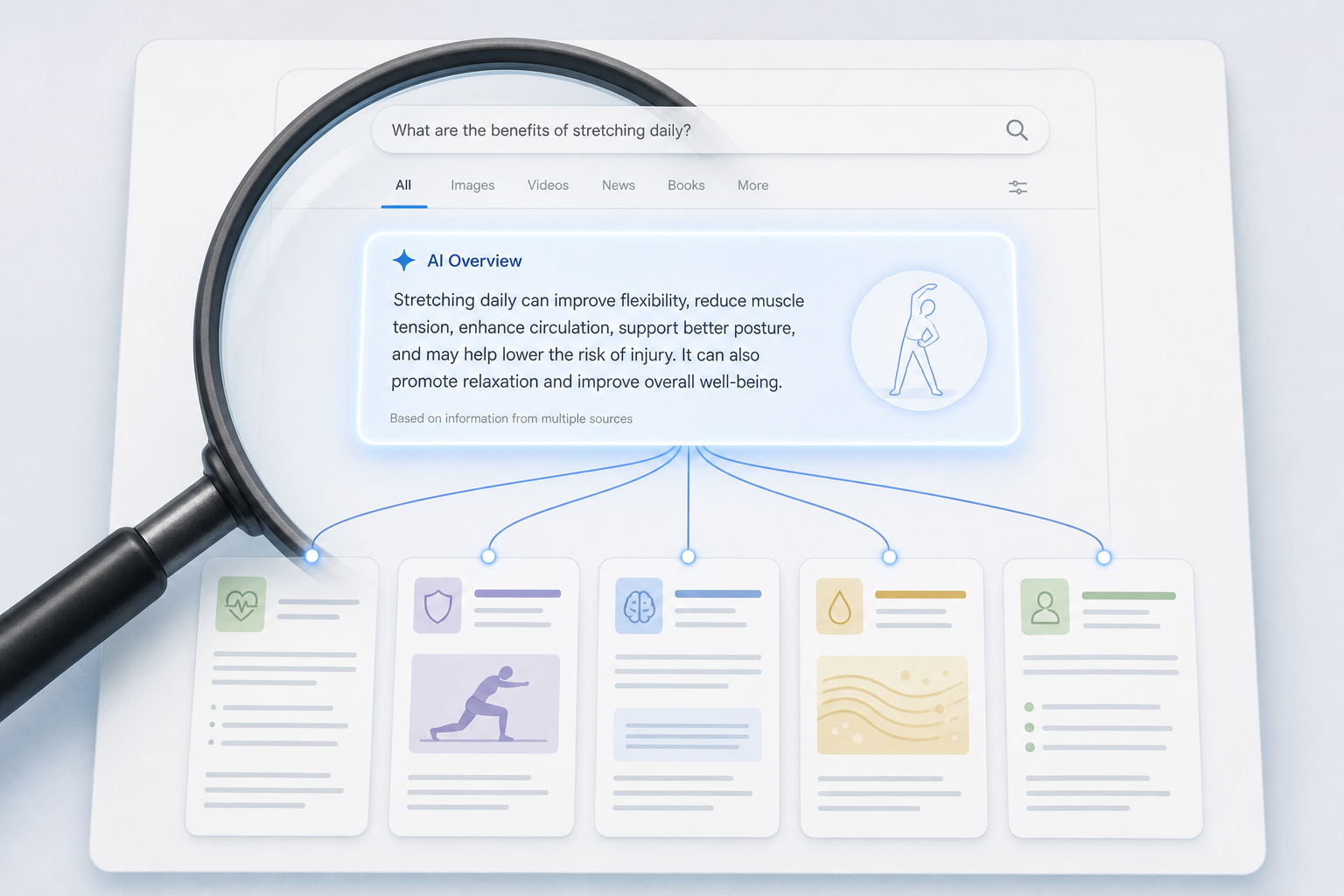
Google AI Overviews are AI-generated summaries that sit at the very top of certain search results pages, above the standard blue links and sometimes just beneath sponsored results. Rather than sending the reader to a single page, an AI Overview synthesises an answer from multiple sources and presents it directly on the results page, with links to the contributing pages shown alongside.
They are triggered most reliably by informational, question-based queries. Informational keywords account for roughly 90% or more of all AI Overview triggers, with that share reaching 91.3% in January 2025. Queries like "how does X work" or "what is the best way to Y" are far more likely to produce an Overview than transactional searches such as "buy running shoes".
Google describes the feature as using multi-step reasoning: for a complex query, the system breaks the question into component parts, answers each, and reassembles them into a single coherent response. The result reads in a conversational tone and can include text, related sources, and video content.
How Google decides which sources to include
There is no separate index for AI Overviews. A page must already be indexed and eligible for a regular Google Search snippet before it can appear in an AI Overview. That single fact has a large practical implication: if your page has indexing problems, a nosnippet directive, or thin content that Google has deprioritised, no amount of AI-specific optimisation will help.
Beyond eligibility, Google uses a process called query fan-out: when a search is complex, the system decomposes it into multiple related sub-queries and runs them in parallel. A page that thoroughly addresses a cluster of related sub-questions gives the retrieval system more material to work with than a page that answers only one narrow question. This is why topical depth matters more than keyword density.
The underlying mechanism is retrieval-augmented generation (RAG), meaning the AI does not rely solely on its training data. It retrieves candidate pages from the live index, extracts relevant passages, and uses those passages to generate the summary. Authority signals, such as quality backlinks and demonstrated expertise, influence which candidate pages are retrieved in the first place.
Content formatting signals Google looks for
Once a page is in the candidate pool, its formatting determines how easy it is to extract a clean, citable answer. Google's systems favour pages where the answer to a question appears in the first paragraph of the relevant section, not buried three paragraphs down after extensive preamble.
The structural pattern that performs consistently well includes: a clear H1 stating the main topic or claim, an opening summary that captures the key point, question-based H2 headings that mirror the language real users search, and concise answer blocks of roughly 40 to 60 words immediately following each H2. Supporting evidence with clear attribution follows the answer block rather than preceding it.
Lists and tables help too, because they present discrete facts in a form that is easy to extract. FAQPage schema markup increases inclusion chances further by making the question-and-answer structure machine-readable, not just visually apparent to human readers. Schema does not guarantee a feature, but it removes ambiguity about what your content is trying to say.
Authority and credibility signals that reinforce eligibility
Formatting alone is not enough. Google's selection process is heavily influenced by signals that indicate a page is trustworthy and authoritative on its topic. Quality backlinks from relevant, credible domains remain one of the strongest signals. A page that answers a question well but has no external credibility is less likely to be retrieved than one that answers it equally well and carries strong link equity.
Demonstrated topical authority matters too. A site that publishes a single well-formatted page on a topic is less competitive than one that covers the topic and its adjacent sub-topics in depth. Covering a subject comprehensively across multiple pages, with clear internal linking between them, signals to Google that the site is a genuine authority rather than a one-off contributor.
Content freshness and factual accuracy also play a role. AI Overviews are designed to surface reliable information, so pages with outdated statistics, ambiguous claims, or thin sourcing are at a disadvantage. Keeping key pages current and grounding claims in verifiable evidence directly supports eligibility.
The scale of the shift and what it means for visibility
AI Overviews now appear on 48% of all Google queries, up from 31% twelve months earlier, and Google reports the feature reaches over 2.5 billion monthly users globally. That prevalence means the top of the search results page looks fundamentally different from what it did two years ago.
For businesses, the practical consequence is that a well-ranked page may receive fewer clicks if an AI Overview answers the question completely without the reader needing to visit any source. The upside is that pages cited within an Overview gain prominent brand exposure and a signal of authority that influences how users perceive the source, even when they do not click through.
The strategic response is not to resist the format but to be the source Google cites. That requires treating content as a structured answer system rather than a collection of articles, and ensuring every high-intent question your audience asks has a clear, well-formatted, authoritative answer on your site.
The best answer wins the citation now, not the best-ranked link.
How to optimise your content for AI Overviews
Audit your existing indexed content
Start by confirming which pages are fully indexed and eligible for snippets in regular Google Search. Use Google Search Console to identify pages with indexing errors, nosnippet directives, or crawl issues. Any page that cannot appear in a standard snippet cannot appear in an AI Overview, so resolving these technical blockers is the prerequisite for everything that follows. Prioritise pages that already rank for informational queries, as these are the most likely AI Overview triggers.
Identify the high-intent questions your audience asks
Map the specific questions real buyers and researchers are typing into Google in your category. Focus on informational queries: "how does X work", "what is the difference between X and Y", "what should I look for when choosing X". Question-based queries trigger AI Overviews far more reliably than transactional ones. Tools like Google Search Console's query report, autocomplete suggestions, and "People also ask" boxes are practical starting points for building this question list.
Restructure pages with direct-answer formatting
For each target question, restructure the relevant page so the answer appears in the first paragraph of the section, not after a lengthy introduction. Use a clear H1 for the page topic, then question-based H2 headings that mirror actual search language. Follow each H2 immediately with a concise 40 to 60 word answer block, then provide supporting detail, evidence, and context below it. Use bullet lists and tables for discrete facts. This format makes it straightforward for Google's retrieval system to extract a clean, citable passage.
Add FAQPage schema and verify structured data
Mark up your question-and-answer content with FAQPage schema so the structure is machine-readable, not just visually apparent. Schema markup removes ambiguity about what your content is answering, increasing the likelihood that Google's system correctly identifies and extracts your answer. Use Google's Rich Results Test to verify that the markup is valid and that no errors are preventing it from being read. Schema is not a guarantee of inclusion, but it is a clear positive signal.
Build topical authority and track your citation position
A single well-formatted page is less competitive than a site that covers a topic and its adjacent sub-questions in depth. Publish a cluster of interlinked pages that together address the full range of questions a buyer in your category would ask. Then monitor whether your pages are being cited in AI Overviews across the queries you are targeting. Tracking citation position over time tells you which pages are working, which need further optimisation, and where new content gaps exist.
Benefits
Top-of-page visibility without paid ads
AI Overviews appear above the standard organic results and often above paid listings, giving cited pages prime real estate on the results page without requiring an advertising budget. For businesses that earn a citation, this is organic exposure at the most prominent position Google offers.
Perceived authority from being cited
When Google's AI selects your page as a source, it functions as a public endorsement of your content's credibility. Users who see your brand cited in an AI-generated answer associate it with expertise, even if they do not click through to your site.
Brand exposure on zero-click searches
Many AI Overview queries are answered completely on the results page, meaning the user never clicks a link. Being cited in that answer still puts your brand name in front of the reader at the moment they are most engaged with the topic, building recognition that influences future search and purchase behaviour.
A defensible content moat against competitors
Structured, authoritative content that earns AI Overview citations is difficult and time-consuming for competitors to replicate. Building topical depth across a cluster of well-formatted pages creates a durable advantage that grows as Google's AI features expand further across query types.
Frequently asked questions about Google AI Overviews
What are Google AI Overviews and how do you get featured in them?
Google AI Overviews are AI-generated summaries that appear at the top of certain search results pages, synthesising answers from multiple sources. To get featured, your page must first be fully indexed and eligible for a standard Google snippet, then formatted with clear question-based headings, direct answer blocks in the first paragraph of each section, and FAQPage schema markup. Topical authority and quality backlinks further increase the likelihood of being selected as a cited source.
Do AI Overviews replace featured snippets?
AI Overviews and featured snippets are distinct features. Featured snippets pull a single passage from one page and display it in a box; AI Overviews synthesise information from multiple sources into a conversational summary with several linked references. Both can appear on the same results page, and optimising for one tends to reinforce eligibility for the other because both favour clear, directly structured answers.
Can small businesses realistically compete for AI Overview citations?
Yes, particularly in specific niches or local categories where the overall competition for informational queries is lower. Topical depth within a focused subject area is more important than overall domain size. A local service business that thoroughly answers every relevant question in its category can outcompete larger, less focused sites for the sub-queries that trigger AI Overviews in that niche.
Does schema markup actually help with AI Overview inclusion?
FAQPage schema markup increases inclusion chances by making question-and-answer structure machine-readable rather than just visually apparent. Google's retrieval system can identify and extract your answers more reliably when the markup is present. It is not a guarantee of inclusion, but it removes ambiguity and is consistently cited as a positive signal for AI-generated search features.
How long does it take to see results after optimising for AI Overviews?
There is no fixed timeline, as it depends on how quickly Google recrawls your updated pages and how competitive the query landscape is. Pages that are already indexed and ranking for informational queries tend to see the fastest impact after restructuring, because they are already in the candidate pool. New pages need to earn indexing and some authority signals before they become eligible.
How widely are AI Overviews currently deployed across Google Search?
AI Overviews now appear on 48% of all Google queries, up from 31% twelve months earlier, and Google reports the feature reaches over 2.5 billion monthly users globally. The vast majority of triggers are informational queries, with that category accounting for roughly 90% or more of all AI Overview appearances.
Structure your content to be cited by Google AI Overviews
AI Overviews are now a permanent part of how Google delivers answers, and the businesses that earn citations are those whose content is structured, authoritative, and directly responsive to the questions buyers are asking. Miracly automates the research, formatting, and publishing of exactly this kind of content, tracking your citation position across AI engines in real time so you can see what is working and where to focus next.