AI and SEO: How Artificial Intelligence Is Changing Search Optimization
AI is rewriting SEO: what that means for your visibility
Search engines now interpret intent, evaluate authority, and assemble answers - understanding the shift is the first step to staying found.
See how AI search engines see your brand
Discover where your brand stands in AI-generated search answers and what it takes to get cited.
How AI algorithms now evaluate content
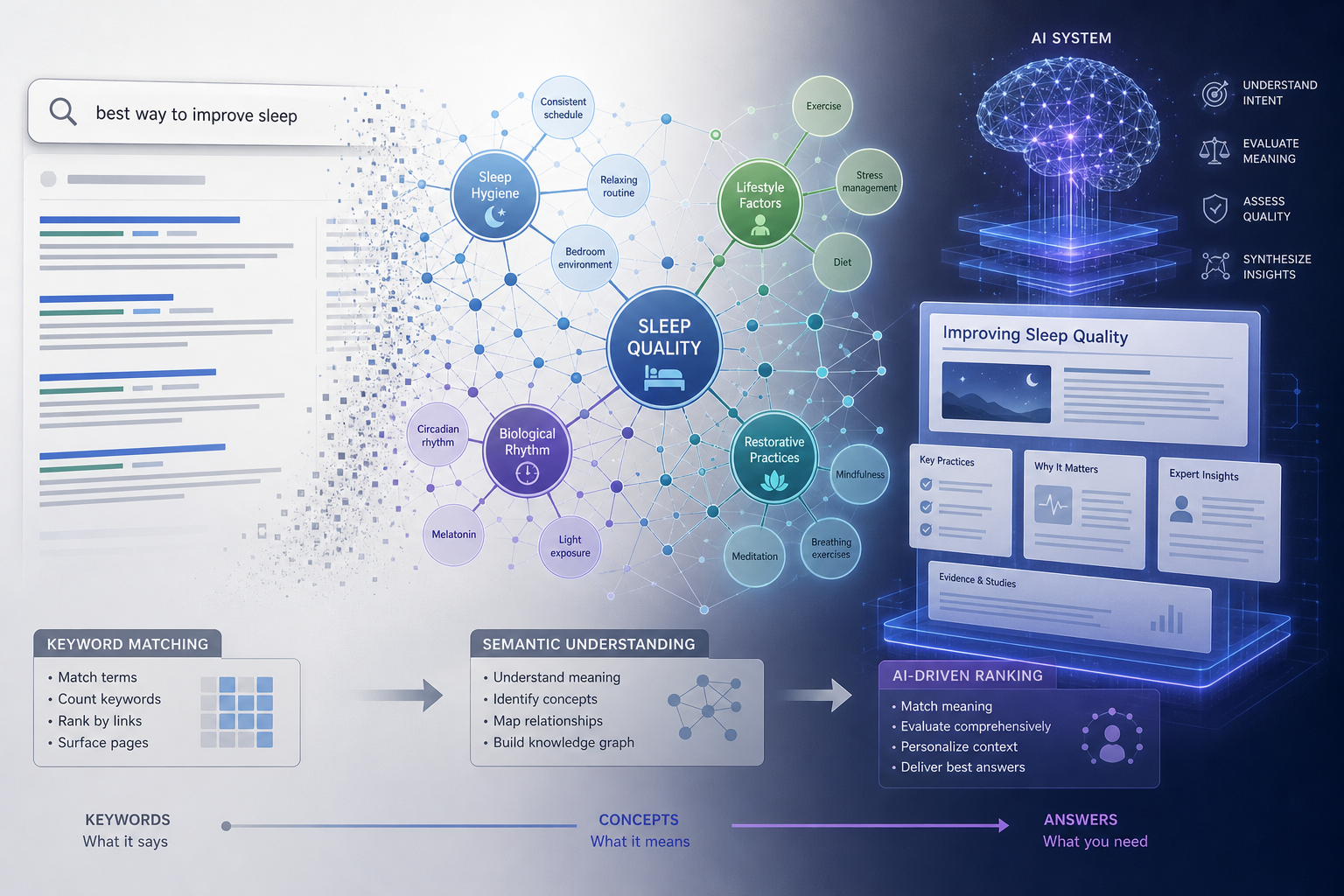
Modern search algorithms no longer count keywords and tally backlinks in isolation. They interpret what a page is actually about, who wrote it, and whether the claims it makes can be cross-referenced against trusted sources. Google's systems use natural language processing to understand the intent behind a query and match it to content that satisfies that intent, not just content that repeats the query's exact words.
The practical consequence is significant. Google rewrites more than 60% of title tags to better reflect search intent, which signals how deeply its systems now prioritise semantic understanding over raw text matching. The March 2025 Core Update went further, integrating E-E-A-T signals (experience, expertise, authoritativeness, and trustworthiness) directly into core ranking systems rather than treating them as secondary checks. Pages with clear authorship signals, cited sources, and verifiable claims now carry a structural advantage. AI-powered search has, in effect, replaced a rules-based ranking model with an interpretation and validation model: instead of ranking pages, the system evaluates entities, cross-checks claims, and assembles answers from what it judges to be the most reliable sources.
AI as a productivity tool inside traditional SEO
Before addressing how AI changes where traffic goes, it is worth being precise about how AI is already changing how SEO work gets done. Generative AI tools can now compress the most time-consuming parts of a traditional SEO workflow: drafting content briefs, expanding keyword clusters, generating structured schema markup, auditing pages for technical issues, and producing first drafts at scale.
The productivity gains are real, but they come with a well-documented risk. Content produced at volume without genuine expertise or original perspective tends to score poorly on the quality signals that modern ranking systems are specifically designed to detect. The March 2024 Core Update reduced unhelpful content in search results by 40%, targeting exactly the kind of thin, algorithmically assembled pages that AI generation can produce when used without editorial discipline. The right framing for AI as a productivity tool is that it accelerates the work of creating genuinely useful content; it does not substitute for the judgment that makes content worth citing in the first place.
AI Overviews are redirecting where traffic flows
The most immediate structural change for SEO practitioners is the rise of AI-generated answer summaries at the top of search results. Google's AI Overviews now appear in a substantial share of all searches, and their presence measurably suppresses clicks to organic results. Organic click-through rates drop by 61% on searches that trigger AI Overviews, falling from 1.76% to 0.61%. A Pew study of nearly 69,000 searches found that only 8% of users whose searches triggered AI Overviews clicked through to a source, compared with 15% when no AI summary appeared.
The implication is not that organic SEO is irrelevant. It is that ranking in position one no longer guarantees the traffic it once did if an AI-generated summary sits above the results and resolves the query without requiring a click. The strategic question shifts from 'how do I rank?' to 'how do I get cited inside the answer?' - which requires a different kind of content architecture than traditional SEO has demanded.
Generative engine optimization and the new citation logic
Generative engine optimization (GEO) is the discipline of structuring content so that AI systems, including ChatGPT, Perplexity, Google's AI Overviews, and similar engines, understand, trust, and cite it when assembling answers. It is distinct from traditional SEO in a specific way: the audience for the content is, in the first instance, a machine that reads structure before a human reads prose.
What AI systems favour is well-documented in practice. Pages with at least one cited statistic from a named source ranked 2.3x higher on average than pages with no citations, according to BrightEdge's 2025 post-update research. Clear entity definitions, structured headings, schema markup, and factually grounded claims all improve the probability that an AI system will treat a page as a reliable source worth including in a generated answer. Google's 2025 knowledge graph cleanup, which removed billions of entities and focused on well-typed entities like 'writer' or 'author', reinforces the same principle: specificity and verifiability are the signals AI systems are increasingly built to reward.
Building a strategy that works across both surfaces
The marketers who will fare best in the current environment are those who stop treating traditional SEO and AI search visibility as separate workstreams. The underlying quality signals overlap considerably: genuine expertise, clear structure, verifiable claims, and content that actually answers the question a reader is asking. What differs is the technical layer.
For traditional search, that layer includes title tags, meta descriptions, canonical URLs, and backlink profiles. For AI search, it includes schema markup, entity clarity, internal linking that helps AI crawlers understand relationships between pages, and a content architecture that makes it easy for a generative system to extract a precise, citable answer. Tracking performance also changes: ranking position in a traditional SERP and citation frequency in AI-generated answers are different metrics that require different monitoring tools. A complete AI SEO strategy in 2025 accounts for both surfaces, measures both, and produces content that earns trust from algorithmic systems and human readers alike.
The best content for AI search is the same content humans trust; AI just reads the structure underneath.
Benefits
Early-mover citation advantage
AI systems build citation patterns based on which sources they have already learned to trust. Brands that establish structured, authoritative content early are more likely to be included in AI-generated answers before competitors fill those slots, and citation patterns tend to compound over time rather than reset with each algorithm update.
Visibility across multiple AI engines simultaneously
Optimising for AI search is not engine-specific in the way that traditional SEO was Google-centric. Content structured for AI citation tends to perform across ChatGPT, Perplexity, Google AI Overviews, and Claude simultaneously, because the underlying quality signals, clarity, verifiability, and structure, are shared across systems.
Reduced dependence on a single ranking surface
As AI Overviews suppress click-through rates from traditional organic results, brands that are cited inside those summaries maintain a presence even when clicks decline. Diversifying across traditional SERP rankings and AI citation slots reduces the risk that a single algorithm update can eliminate a brand's search-driven traffic overnight.
Content that earns trust from algorithms and readers
The signals AI ranking systems reward, factual grounding, clear authorship, cited sources, and specific expertise, are the same signals that build reader trust. Adapting content for AI search does not require compromising quality for humans; it requires making the quality that already exists legible to machines.
Measurable position in AI-generated answers
Unlike brand awareness, AI citation frequency is trackable. Monitoring how often and in what context a brand is cited across AI engines provides a concrete performance metric that complements traditional rank tracking, giving marketers a clearer picture of how buyers are actually encountering their brand during research.
How AI-era SEO plays out in practice
A local physio losing traffic to AI answers
A physiotherapy clinic that ranked well in local map-pack results starts seeing a drop in appointment enquiries despite maintaining its rankings. The cause is that AI Overviews are now answering questions like 'best physio for lower back pain near me' directly in the search results, resolving the query before users reach the map pack. The clinic's website, built for human readers, lacks the structured schema markup and entity clarity that would allow an AI system to cite it as a recommended provider. Adapting means restructuring key pages so that AI crawlers can extract specific, verifiable information about the clinic's specialisms, location, and credentials.
A B2B company whose buyers now research via ChatGPT
A software company selling project management tools to mid-market businesses finds that its sales team is fielding fewer inbound leads from Google, but buyers are arriving at demos already familiar with the product's positioning. Those buyers have been researching via AI assistants, asking questions like 'what project management tools are best for remote engineering teams'. The company's content is not structured for AI citation, so competitors with better-formatted, factually grounded pages are being named in AI-generated comparisons instead. Getting cited in AI-generated answers in this context functions like appearing in a buyer's shortlist before the conversation even starts.
An e-commerce brand optimizing for AI product answers
An online retailer selling specialist outdoor equipment notices that conversational AI assistants are increasingly being used to answer questions like 'what sleeping bag is best for winter camping'. The retailer's product pages are optimised for traditional search with keyword-rich descriptions, but they lack the structured data and comparative framing that AI systems use when assembling product recommendation answers. Restructuring product pages to include clear specifications, use-case context, and schema markup makes them far more likely to be extracted and cited by generative engines answering buyer questions.
A marketing agency managing AI visibility for multiple clients
An agency managing SEO for a portfolio of clients across different industries needs to monitor not just traditional SERP rankings but also how each client is represented in AI-generated answers across ChatGPT, Perplexity, and Google AI Overviews. Managing this manually across multiple engines and markets is not scalable. The agency's priority is a system that continuously tracks citation frequency and brand mentions across AI engines, generates structured content pages engineered for AI citation, and reports on performance in a single dashboard without requiring a separate seat for every team member.
Frequently asked questions about AI and SEO
Does AI SEO replace traditional SEO, or do they work alongside each other?
They work alongside each other, but the balance is shifting. Traditional SEO, covering technical health, backlinks, and SERP rankings, remains relevant because search engines still return ranked results for most queries. What has changed is that AI-generated summaries now intercept a growing share of clicks before users reach those results, so optimising only for traditional rankings leaves a significant and growing surface unaddressed. A complete strategy accounts for both.
How do AI engines decide what content to cite in generated answers?
AI systems evaluate content on signals that overlap with but extend beyond traditional ranking factors. Factual grounding, clear entity definitions, cited sources, schema markup, and structured headings all increase the probability of citation. Research from BrightEdge found that pages citing at least one statistic from a named source ranked 2.3x higher on average than uncited pages, which illustrates how verifiability functions as a trust signal for AI systems specifically.
Can AI-generated content rank well in search results?
AI-generated content can rank, but only when it meets the same quality standards as human-written content. Google's systems are specifically designed to detect and demote thin, unhelpful content regardless of how it was produced. The March 2024 Core Update reduced unhelpful content in results by 40%, targeting exactly the kind of volume-produced, low-expertise pages that AI generation can create without editorial oversight. AI tools work best as an accelerant for skilled writers, not a replacement for expertise.
What is the difference between GEO and SEO?
SEO (search engine optimization) is the practice of improving a page's visibility in traditional ranked search results. GEO (generative engine optimization) is the discipline of structuring content so that AI systems cite it when assembling generated answers. The two share underlying quality principles, but GEO requires additional attention to content architecture, entity clarity, schema markup, and the specific formatting that AI agents prefer when extracting information to include in a response.
How do I track whether my brand is being cited in AI-generated answers?
Traditional rank tracking tools measure SERP positions but do not capture AI citation frequency. Tracking AI visibility requires querying AI engines directly with the high-intent questions your buyers are asking and monitoring whether your brand appears in the generated answers, and in what context. This needs to be done continuously across multiple engines and markets, since AI-generated answers are dynamic and can change as the underlying models are updated.
What content changes most improve AI search visibility?
The highest-impact changes are structural rather than stylistic. Adding schema markup, clear factual claims with cited sources, specific entity definitions (who wrote the content, what the business does, what area it serves), and structured headings that allow AI crawlers to extract precise answers all improve citation probability. Pages that answer a specific question completely and verifiably, rather than covering a topic broadly and vaguely, are consistently favoured by generative systems assembling targeted responses.
Your buyers are researching in AI assistants right now
Understanding how AI is changing search is the first step. The next is knowing where your brand stands inside AI-generated answers today, and what structured content it would take to get cited more consistently. Miracly tracks your AI citation position across multiple engines and markets, and generates the kind of structured, authoritative content pages that AI systems are built to trust.