GEO vs SEO: What's the Difference and Which One Do You Need?
SEO gets you ranked. GEO gets you cited. Here is why both now matter.
Understand the real difference between GEO and SEO, and figure out which one your business actually needs right now.
See your AI search visibility right now
Check where your business stands in AI-generated answers before your competitors claim that ground.
SEO is not going anywhere, and here is why
Search engine optimization is the practice of making web pages rank higher in traditional search results, primarily Google, which still holds nearly 82% of the global search engine market. The goal is a click: a user sees your page listed, clicks through, and lands on your site. That model has powered digital marketing for decades and continues to deliver. Organic search drives 53% of all website traffic, and for B2B companies the figure climbs to 64%. Google processes 8.5 billion searches daily, so the volume is not in question.
SEO works through a well-understood playbook: technical site health, keyword targeting, quality content, backlinks, and structured data. The competitive difficulty is real, with 96.55% of all pages receiving zero organic traffic from Google, but the channel itself remains the highest-reach option in digital marketing. Any business that depends on organic discovery cannot afford to ignore it. For more on how AI is beginning to intersect with this established discipline, see AI for SEO: what it means and how to use it.
What GEO is and how AI engines consume content
Generative Engine Optimization is the practice of structuring and writing content so that AI-powered answer engines, including ChatGPT, Perplexity, Google's AI Overviews, Gemini, and Claude, can understand, surface, and cite it inside their generated responses. The intended output is not a ranked link but a direct mention or quotation within the AI's answer, often without the user ever clicking through to your site.
AI engines consume content differently from traditional crawlers. Queries to AI assistants average 23 words, compared to roughly four words on Google, which means users are asking detailed, intent-rich questions and expecting synthesized answers. Platforms like Perplexity cite approximately 7.3 domains per response on average, while ChatGPT cites approximately 5.0. Critically, only 11% of citations overlap between ChatGPT and Perplexity, meaning a single content strategy does not reach both audiences equally. Content that is factually grounded, well-structured, and answers questions directly within the first 100 words performs best. Pages with tables, for instance, are cited approximately 2.5 times more often than unstructured pages of comparable length. Learn more about one specific surface in what are Google AI Overviews and how do you get featured in them.
SEO and GEO compared side by side
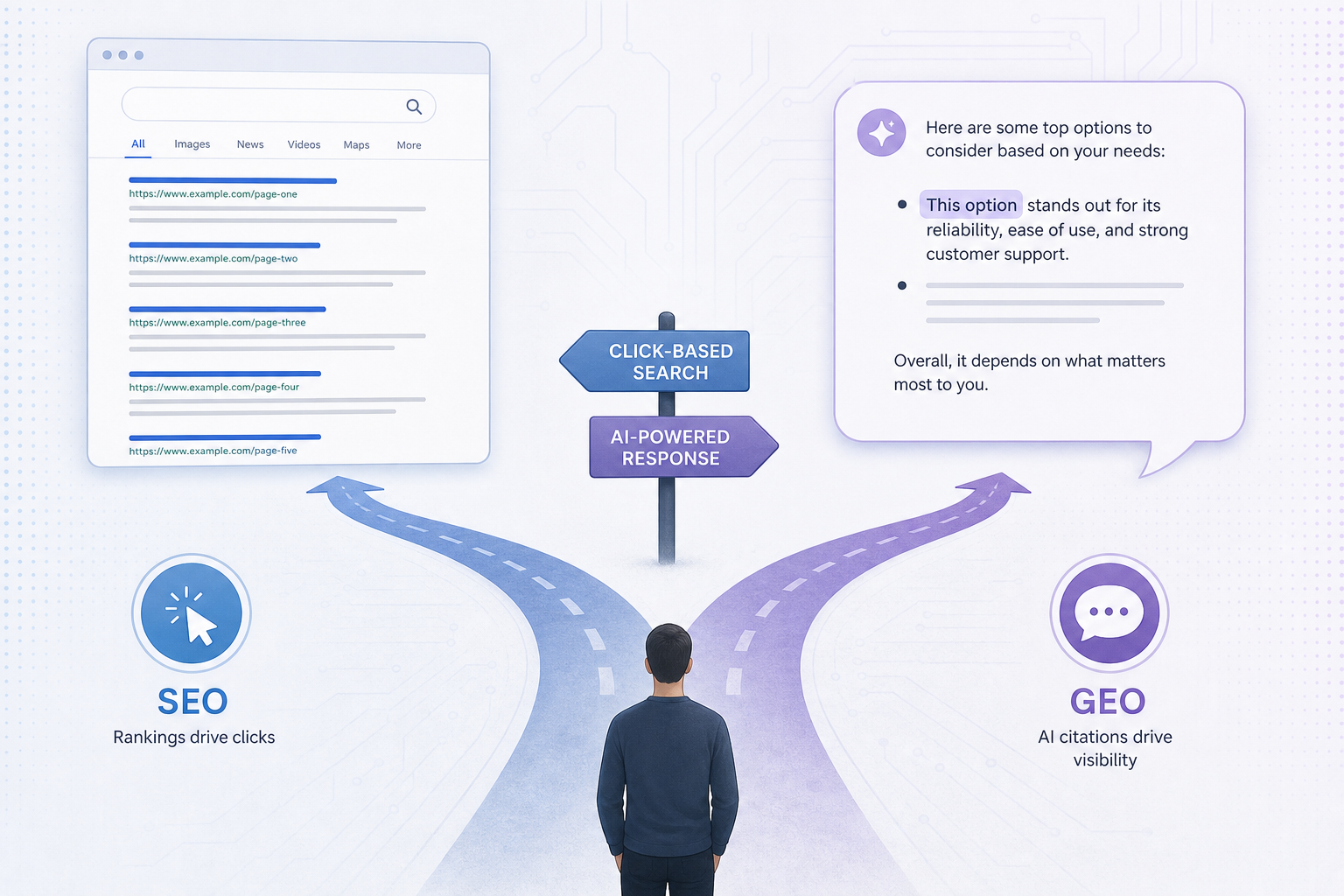
The clearest way to see the difference is to look at what each discipline optimizes for. SEO optimizes for ranked position on a search results page; GEO optimizes for citation inside an AI-generated answer. SEO success is measured in clicks, rankings, and organic sessions. GEO success is measured in how often your brand or content is mentioned, quoted, or recommended by an AI engine, sometimes called a zero-click brand mention.
The content requirements diverge significantly. SEO rewards keyword density, backlink authority, and page speed. GEO rewards factual precision, clear structure, direct answers, and consistent messaging across all digital touchpoints, because AI models aggregate signals from many sources before deciding what to cite. Schema markup, which helps both disciplines, is more critical for GEO because it makes content machine-readable in the way AI agents prefer. See how broken structured data costs you rich results and AI citations for a concrete example of where the two channels intersect technically.
The channels are not mutually exclusive. As search engines integrate generative AI into their core experiences, the two disciplines increasingly share infrastructure even as their goals differ.
Which one your business actually needs right now
The honest answer for most businesses is: both, but in different proportions depending on where your buyers are searching. If your customers still primarily use Google to find services like yours, a strong SEO foundation remains non-negotiable. Abandoning it to chase AI citations would be premature.
The case for adding GEO grows stronger the more your buyers use AI assistants for research. B2B buyers who ask ChatGPT or Perplexity for vendor recommendations, local service seekers who ask an AI assistant for the best physiotherapist nearby, or international shoppers who query Gemini in their own language: these are audiences that SEO alone cannot reach. GEO is not a replacement for SEO; it is the layer that captures the audience that has already moved. For a deeper look at how artificial intelligence is reshaping the broader search landscape, AI and SEO: how artificial intelligence is changing search optimization is worth reading alongside this page.
How Miracly fits into a GEO strategy
Miracly is built specifically for the GEO layer. It analyzes a business's website, researches the high-intent questions real buyers are asking AI assistants, and automatically generates structured content pages engineered to be cited by AI agents. These pages are published alongside an existing site without altering it, so there is no disruption to an established SEO setup.
The platform operates as an ongoing system rather than a one-time audit. It continuously researches new questions, writes and schedules pages, and tracks a business's citation position in real time across multiple AI engines and markets. Content can be produced in over 40 languages, which matters because citation overlap between platforms is low and international audiences require their own coverage. A built-in AI assistant called Mira manages the content strategy from a single dashboard. Supporting tools include schema markup, internal linking, sitemap generation, Google Search Console integration, competitor tracking, and branded mention monitoring. For businesses that want to compare this approach against a broader SEO platform that has added AI features, Semrush AI visibility toolkit vs. Miracly: which is right for you offers a direct comparison.
SEO vs GEO: which approach fits your situation
Both disciplines are legitimate and increasingly complementary. The right emphasis depends on where your buyers are searching today.
If your buyers are still primarily on Google and your SEO foundation is solid, a traditional SEO investment remains the right priority. If your buyers are moving to AI assistants, or if you want to capture both channels, Miracly is built for the GEO layer that traditional SEO tools do not cover.
In traditional search you compete for a click; in AI-driven discovery you compete to be the source an AI trusts enough to quote.
Benefits
Visibility inside AI-generated answers
GEO places your brand directly inside the responses AI engines deliver to users, not just on a results page they may or may not scroll through. Being cited by ChatGPT or Perplexity puts your brand in front of a buyer at the exact moment they are forming a decision, without requiring a click.
Zero-click brand mentions at scale
AI answers frequently name sources without linking to them, which means brand recognition accumulates even when no click occurs. Consistent citation across multiple AI engines builds category authority in a way that traditional ranking metrics do not capture.
Multilingual reach across 40-plus languages
AI citation overlap between platforms is low, and international markets require their own content coverage. Producing GEO-optimized pages in over 40 languages means your brand can be cited by AI engines serving audiences that your English-language SEO strategy does not reach.
Real-time tracking across multiple AI engines
Knowing your Google ranking is no longer sufficient when buyers are consulting ChatGPT, Perplexity, Gemini, and Claude. Tracking your citation position across all major AI engines in real time gives you the data to act on GEO performance the same way you act on SEO rankings.
Future-proofing as search continues to shift
Search engines are integrating generative AI into their core experiences, and the share of queries handled by AI assistants is growing. Building a GEO presence now, while citation competition is still relatively open, positions a brand ahead of the curve rather than scrambling to catch up after the shift has consolidated.
Four business scenarios: SEO, GEO, or both
Local physiotherapy clinic losing new patients
A physiotherapy clinic that built its patient base through Google rankings is seeing fewer new inquiries as more potential patients ask AI assistants which clinic to visit nearby. SEO alone does not place the clinic inside those AI-generated recommendations. Adding a GEO layer, with structured content pages that answer the specific questions buyers ask AI assistants, is what gets the clinic cited. This scenario calls for both disciplines: SEO to hold Google visibility, and GEO to capture the growing share of patients who start their search with an AI assistant rather than a search bar. Miracly's AI visibility audit is a practical starting point for clinics in this position.
B2B software company targeting procurement teams
B2B buyers increasingly use AI assistants to shortlist vendors before ever visiting a company website. Organic search still matters, with 64% of B2B traffic coming from organic search, but the buyer who asks Perplexity or ChatGPT for the best project management tool for a mid-sized engineering team is a buyer SEO cannot reliably reach. A B2B company in a competitive category needs GEO-optimized content that answers the precise, long-form questions procurement teams are asking AI engines, so the brand appears in the synthesized answer. This is a clear case where GEO adds a channel that SEO does not cover.
Marketing agency managing multiple brand clients
A marketing agency running SEO campaigns for several clients faces a new challenge: clients are starting to ask why they are not appearing in ChatGPT or Perplexity answers. Managing GEO across multiple brands requires tracking citation positions across several AI engines simultaneously, producing structured content at scale, and reporting on a metric that most SEO platforms do not yet measure. A platform with unlimited seats, multi-engine tracking, and automated content generation fits this workflow far better than adapting a traditional SEO tool. Miracly's dashboard is designed for exactly this multi-client, multi-engine management need.
International e-commerce brand expanding into new markets
An e-commerce brand entering several new language markets cannot rely on its English-language SEO strategy to generate AI citations in those markets. AI engines in different regions draw on locally relevant sources, and citation overlap between platforms is only 11%, meaning a strategy that works for ChatGPT may not reach Perplexity users in the same market, let alone users in a different language. Multilingual GEO content, written in over 40 languages and structured for AI consumption, addresses this gap directly. SEO remains necessary for baseline discoverability, but GEO is the mechanism that earns citations in markets where the brand has no established authority yet.
GEO vs SEO: questions readers ask most
Does GEO replace SEO?
No. GEO and SEO serve different channels and different user behaviors. SEO drives clicks from traditional search results, which still account for the majority of web traffic for most businesses. GEO earns citations inside AI-generated answers, which is a growing but distinct channel. The two disciplines share some underlying infrastructure, such as structured data and factual content, but they optimize for different outputs. Most businesses need both, with the balance depending on where their buyers are actually searching.
Can my current website do GEO without changes?
Most websites built for human readers are not structured the way AI agents prefer to consume information. AI engines favor content that places a direct answer within the first 100 words, uses clear structure such as tables and lists, and is factually grounded with supporting citations. A site that ranks well on Google may still be poorly positioned for AI citation. GEO typically requires additional structured content pages designed specifically for AI consumption, published alongside the existing site rather than replacing it.
How do I measure GEO results?
GEO performance is measured by citation frequency: how often your brand or content is mentioned, quoted, or recommended inside AI-generated responses across the engines that matter to your audience. Traditional SEO metrics like rankings and organic sessions do not capture this. Effective GEO measurement requires tracking citation positions across multiple AI engines, including ChatGPT, Perplexity, Gemini, and Claude, in real time. Miracly's AI search rank tracker is built specifically for this purpose.
Which AI engines matter most for GEO?
The answer depends on your audience, but the major platforms to cover are ChatGPT, Perplexity, Google's AI Overviews, Gemini, and Claude. Citation behavior varies significantly between platforms: Perplexity cites approximately 7.3 domains per response on average, while ChatGPT cites approximately 5.0, and only 11% of citations overlap between the two. This means a strategy optimized for one platform does not automatically transfer to another, and broad coverage across engines is more effective than focusing on a single one.
How long before GEO efforts produce results?
GEO is an ongoing content system rather than a one-time fix, and citation authority builds over time as AI engines encounter your structured content repeatedly across multiple queries. There is no universally verified timeline, because citation frequency depends on the competitiveness of your category, the quality and structure of your content, and how frequently the relevant AI engines re-index sources. What is clear from the research is that content should be updated at minimum every 12 to 18 months to remain competitive, and that consistent, well-structured publishing accelerates citation frequency.
Is GEO relevant for local businesses, not just large brands?
Local businesses are among the most directly affected by the shift to AI-driven discovery. A potential customer who asks an AI assistant for the best accountant or restaurant in their area is bypassing Google entirely, and a local business with no GEO presence is simply invisible in that interaction. Because AI engines synthesize answers from structured, factual content, a well-optimized local business can earn citations alongside much larger competitors. GEO levels the playing field in a way that traditional SEO, dominated by domain authority and backlink volume, often does not.
Ready to appear in AI answers, not just search results
Miracly is built for the GEO layer: it researches the questions your buyers are asking AI assistants, generates structured content pages engineered to be cited, and tracks your citation position across every major AI engine in real time. If your business is ready to move beyond traditional search rankings and claim visibility in AI-driven discovery, Miracly is where that work happens.