Best AI Visibility Tools: How to Choose the Right Platform
Choosing the right AI visibility tool starts with knowing what each one actually tracks
A clear-eyed guide to evaluating AI visibility platforms, from monitoring-only tools to full optimization systems.
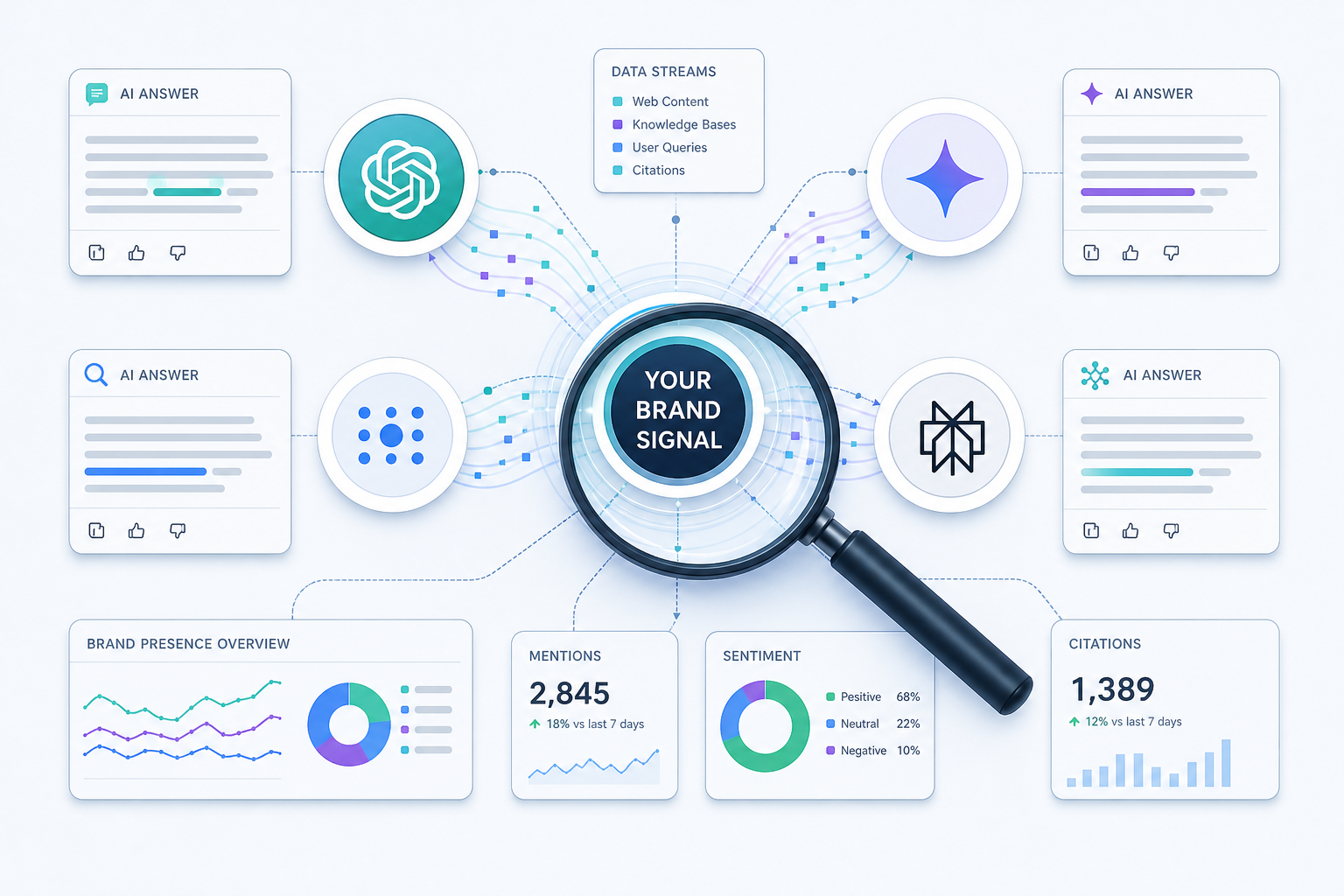
See how your brand appears in AI-generated answers
Explore Miracly's AI visibility tools and see exactly where your brand stands across ChatGPT, Perplexity, Google AI Overviews, and more.
AI visibility is not the same discipline as SEO
Traditional SEO tools measure rankings, traffic, and conversions inside conventional search engines. AI visibility is a different channel entirely. When a buyer asks ChatGPT which accountant to hire, or asks Perplexity to recommend a physio nearby, no ranked list of blue links appears. A single synthesized answer does, and either your brand is in it or it isn't. As one framing puts it, SEO tracks traffic, rankings, and conversions; AEO looks at mentions, citations, and brand visibility. That distinction matters because the tools built for one task are poorly suited to the other. A keyword rank tracker tells you nothing about whether ChatGPT cites your website. An AI visibility platform is built specifically to answer that question, and to help you do something about it. To understand how this shift is reshaping the broader discipline, AI and SEO: how artificial intelligence is changing search optimization is worth reading alongside this guide.
What AI visibility tools actually do, and where they differ
The category splits into two distinct functions: monitoring and optimization. Monitoring tools track how your brand appears in AI-generated answers across LLMs like ChatGPT, Gemini, Claude, Perplexity, and Google AI Overviews. They surface metrics such as brand mentions, citation rate, share of voice, sentiment, and prompt position. Optimization tools go further: they provide recommendations, or directly produce the structured content and entity signals that cause AI systems to cite a brand more often and more accurately. Many platforms in this space focus primarily on monitoring. They give you a clear picture of where you stand but leave the work of improving that picture to you. A full-stack platform combines both: it tracks your position across engines and actively generates the content that moves it. Understanding what Google AI Overviews are and how to get featured in them illustrates concretely why optimization, not just measurement, is where the real leverage sits.
The criteria that separate good platforms from great ones
Breadth of AI sources is the first filter. An analysis of 3.7 million AI citations found that 91% of cited URLs appear in just one LLM, which means tracking only one engine gives a deeply incomplete picture. A credible platform should cover at minimum ChatGPT, Gemini, Claude, Perplexity, and Google AI Overviews, with coverage extending to Grok, DeepSeek, and Copilot where relevant. The second criterion is data methodology: AI answers change by session, country, and whether the model ran a live web search. Tools that run multiple replicates per prompt, per provider, and per market produce normalized metrics you can actually act on. Single-snapshot tools produce noise. Third, look at whether the platform benchmarks your brand against competitors, not just in absolute terms. Share of voice and competitor gap analysis tell you whether you are gaining or losing ground. Finally, ask whether the platform generates optimized content or only reports on existing content. Measurement without action is useful; measurement combined with automated content generation is a competitive advantage.
Where monitoring-focused tools fit and where they stop
Dedicated monitoring platforms serve a real and legitimate need. A brand team that already has strong content operations and simply needs reliable data on AI citation performance will find a monitoring-only tool sufficient. These platforms typically excel at dashboarding: clean share-of-voice charts, sentiment breakdowns, and competitor mention tracking across multiple LLMs. They are a sensible starting point for teams that want to understand the landscape before committing to a full optimization workflow. The limitation becomes visible when a business needs to actually move the needle. Knowing that a competitor is cited three times more often than you are in Perplexity answers is useful intelligence. Knowing what content to publish to close that gap, and having a system that writes and schedules it automatically, is what converts insight into results. For businesses whose websites were built for human readers and are not yet structured for AI agents, monitoring data alone does not solve the underlying problem. That is the gap where a platform like Miracly operates.
How Miracly fits into this landscape and who it is built for
Miracly is positioned as a full-stack AI visibility system: it monitors citation and mention performance across ChatGPT, Claude, Google AI Overviews, Perplexity, and Gemini, and it also generates the structured content pages that improve those metrics over time. The content is published alongside a client's existing website without altering it, written in over 40 languages, and formatted the way AI agents prefer to consume information. This makes it particularly relevant for businesses that need both measurement and production: local service businesses losing leads to AI answers, B2B companies whose buyers research via ChatGPT, and marketing agencies managing AI visibility for multiple clients at once. The platform also includes schema markup, internal linking, sitemap generation, Google Search Console integration, and competitor tracking, so teams are not assembling a separate stack of point tools. For readers who want to understand the technical underpinning, schema markup: how to test and fix your structured data covers one of the foundational signals that AI agents use when deciding what to cite.
Monitoring-only tools vs. full-stack AI visibility platforms
The core choice in this category is between platforms that measure AI visibility and platforms that both measure and improve it.
A monitoring-only tool is the right choice for a team that already has a mature content operation and needs data to direct it. Miracly is the stronger fit for businesses that need measurement and production together, particularly those targeting multiple AI engines, languages, or markets without a large in-house content team.
Monitoring tells you whether AI engines are citing your brand. Only a platform that also generates structured content can change the answer.
Benefits
Continuous monitoring across multiple AI engines
A full-stack platform tracks your brand's citation rate, share of voice, and sentiment across ChatGPT, Gemini, Claude, Perplexity, and Google AI Overviews simultaneously. Single-engine monitoring misses the majority of AI citations, since research shows 91% of cited URLs appear in only one LLM.
Optimization, not just measurement
Monitoring tells you where you stand; structured content generation changes where you stand. Platforms that combine both functions let teams act on data immediately rather than handing findings off to a separate content workflow. The gap between insight and action is where most AI visibility efforts stall.
Multilingual reach for international audiences
AI search is global, and buyers in different markets use different engines and languages. A platform that generates AI-optimized content in over 40 languages means a business targeting France, Brazil, or Japan can pursue AI visibility in each market without building separate content teams.
Competitor benchmarking built into the workflow
Knowing your own citation rate in isolation is less useful than knowing it relative to competitors. Competitor gap analysis and share-of-voice tracking let teams identify exactly which prompts and topics a rival is winning, and prioritize content accordingly.
A complete supporting stack in one platform
Schema markup, internal linking, sitemap generation, Google Search Console integration, and a social media module mean teams are not stitching together five separate tools. A unified dashboard with unlimited seats reduces coordination overhead for agencies and in-house marketing teams alike.
Who needs an AI visibility platform and when
A local physio practice losing leads to AI answers
A physiotherapy clinic that relied on Google rankings for new patient acquisition finds that an increasing share of potential patients now ask ChatGPT or Perplexity for a recommendation directly. The clinic's website, built for human readers, is never cited. A monitoring tool confirms the problem but cannot fix it. A full-stack platform like Miracly identifies the high-intent questions buyers are asking AI assistants, then generates structured content pages engineered to be cited, published alongside the existing site without altering it. This is the scenario where the combination of measurement and automated content generation has the most direct business impact.
A B2B company whose buyers research via ChatGPT
A software company selling to procurement teams notices that their buyers increasingly arrive having already formed a shortlist using AI assistants. If the company does not appear in ChatGPT or Perplexity answers to questions like 'what is the best project management tool for construction teams', they are invisible at the moment of highest intent. Generative engine optimization addresses exactly this: structuring content so that AI agents surface it when generating direct responses. Competitor benchmarking within the platform shows which rivals are being cited and on which prompts, giving the content team a clear prioritization framework.
A marketing agency managing multiple brand clients
An agency with a portfolio of clients across different industries needs to track AI visibility for each brand, report on progress, and produce optimized content at scale. A monitoring-only tool requires the agency to then commission or write content separately. A platform with unlimited seats, automated content scheduling, and a unified dashboard lets the same team manage the full workflow without switching tools. Miracly's built-in AI assistant, Mira, supports strategy management from a single interface, which matters when the same team is handling ten or more client accounts simultaneously.
A retailer targeting multiple international markets
An e-commerce brand selling across Europe and Latin America needs AI visibility in each market, in the local language, across the engines that dominate in each region. A platform limited to English-language content generation leaves non-English markets unserved. Content generation in over 40 languages, combined with per-market prompt tracking and share-of-voice data, means the brand can pursue AI citation in each market as a distinct, measurable objective rather than an afterthought. This is the use case where multilingual capability moves from a nice-to-have to a core requirement.
Best AI visibility tools: how to choose the right platform
How is AI visibility tracking different from traditional SEO rank tracking?
Traditional SEO rank trackers measure where a URL appears in a list of search results for a given keyword. AI visibility tracking measures whether and how a brand is mentioned or cited inside AI-generated answers, which are synthesized responses that often satisfy a query without the user clicking through to any website at all. The metrics are different: instead of position one through ten, you are tracking brand mentions, citation rate, share of voice, sentiment, and prompt position across multiple LLMs.
Can free AI visibility tools do enough for a serious business?
Free tools typically provide snapshot data with limited query coverage, which is useful for a quick diagnostic but not for ongoing strategy. AI answers change by session, country, and whether the model ran a live web search, so a single snapshot can be misleading. Paid platforms run multiple replicates per prompt, per engine, and per market to produce normalized metrics that are actually actionable. For a business that depends on AI-driven discovery for leads or sales, the gap between snapshot data and continuous monitoring is significant.
Which AI engines should a visibility tool cover?
At minimum, a credible platform should cover ChatGPT, Gemini, Claude, Perplexity, and Google AI Overviews. ChatGPT had over 400 million weekly active users as of February 2025, and Google AI Overviews appear in nearly half of all monthly searches, so those two alone represent enormous reach. Coverage of Grok, DeepSeek, and Copilot adds breadth for brands whose audiences use a wider range of AI tools. Multi-platform tracking is strategically important because 91% of cited URLs appear in just one LLM, meaning your citation profile looks very different depending on which engine you examine.
How often should AI visibility data refresh?
AI answers are not static: the same prompt can return a different answer in a different session, country, or when the model uses live web retrieval. This means point-in-time snapshots are unreliable as a basis for strategy. The most useful platforms run continuous or frequent monitoring, normalize results across multiple replicates, and surface trends over time rather than single data points. How often data refreshes is one of the most important technical questions to ask any vendor before committing.
Do I need content generation, or is monitoring enough?
It depends on whether your existing content is already structured for AI agents. If your website was built for human readers, with long prose pages and no structured data, monitoring will confirm you are not being cited but will not tell you what to publish to fix it. Content generation combined with monitoring closes the loop: you measure where you stand, identify the prompts and topics where competitors are winning, and produce structured pages that give AI engines something to cite. Monitoring alone is a starting point; optimization is what moves the metric.
What is the difference between AEO and GEO, and does it matter which term a platform uses?
Answer engine optimization (AEO) and generative engine optimization (GEO) describe overlapping practices: structuring content so that AI-powered answer engines surface it when generating direct responses to user prompts. AEO tends to emphasize the answer-delivery mechanism; GEO emphasizes the generative model layer. In practice, both terms refer to the same strategic discipline, and the terminology a platform uses matters less than whether it actually helps you appear in AI search results across the engines your buyers use.
Find out where your brand stands in AI-generated answers
If your buyers are already using ChatGPT, Perplexity, or Google AI Overviews to research their options, the question is not whether AI visibility matters for your business. It is whether your brand appears when those answers are generated. Miracly tracks your position across every major AI engine and builds the structured content that gets you cited. Explore the platform and see where you stand today.