Best AI SEO Tools: A Comparison for Businesses Targeting AI Search
Choosing the right AI SEO tool when generative search has changed the rules
A clear-eyed comparison of AI SEO tools for businesses that need to be cited, not just ranked.
Find the AI SEO tool built for how buyers search today
Pick the platform that matches where search is heading, not where it has been.
Why AI SEO tools became a category in the first place
Traditional SEO required teams to manually research keywords, audit pages, map internal links, and track rankings across hundreds of variables. AI SEO tools emerged to automate and accelerate that work using machine learning and natural language processing. Today, a capable platform can handle keyword clustering, rank tracking, backlink analysis, and on-page audits with far less manual input than traditional software required.
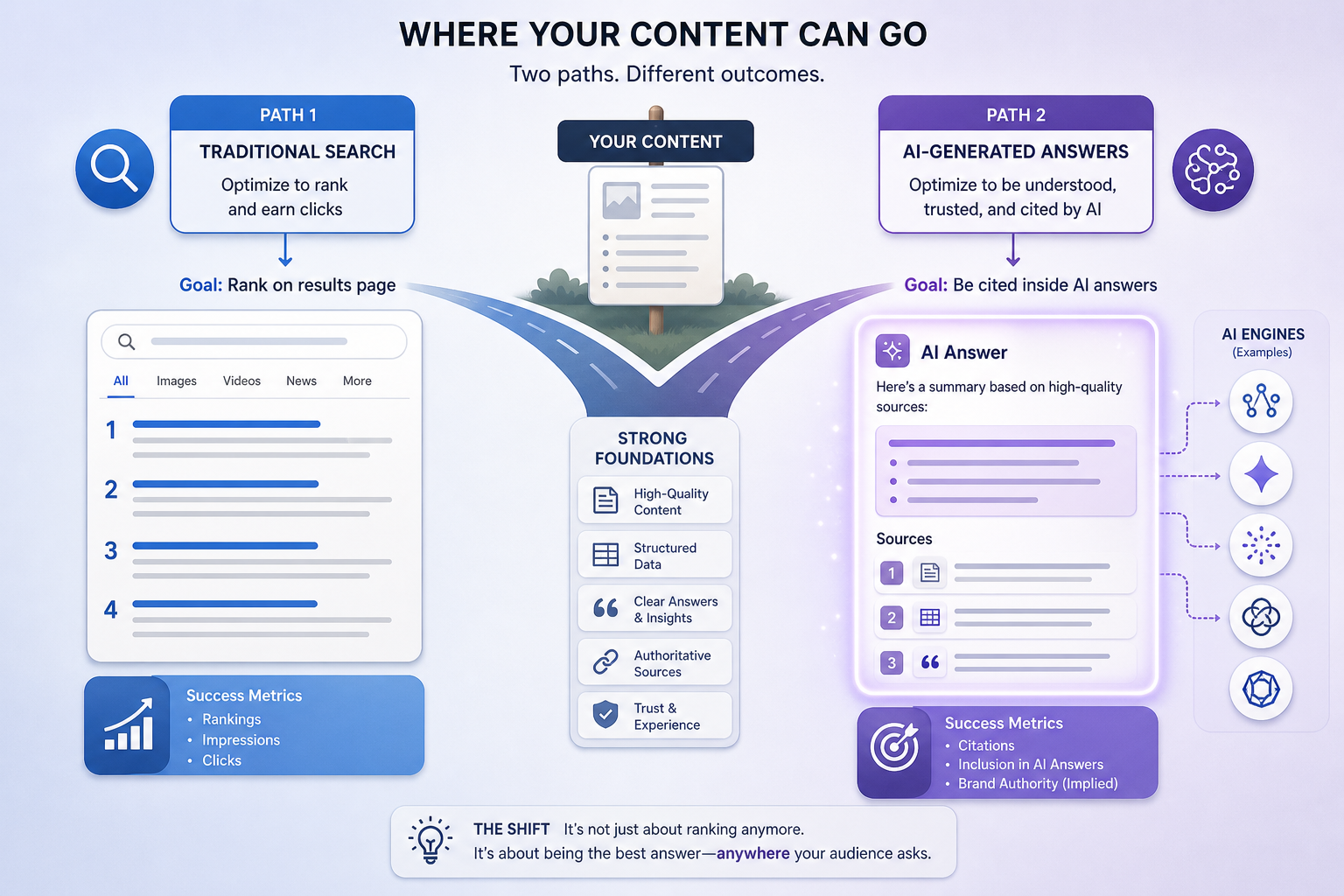
But the category has been reshaped by something larger than automation. Google launched AI Overviews in May 2024, integrating generative AI directly into search results. Informational queries are now dominated by AI-generated answers, and studies confirm that clicks to organic results drop significantly when an AI Overview is present. The implication is direct: ranking well is no longer enough if the AI answer absorbs the click before a user reaches your page. AI SEO tools that were built before this shift can still help with the fundamentals, but they were not designed for a world where visibility means being cited inside an AI-generated answer.
The distinctions that actually matter when comparing tools
Not all AI SEO tools are solving the same problem. The first split worth understanding is content generation versus technical SEO. Some platforms focus on writing and optimizing text, helping teams produce articles, meta descriptions, and structured pages faster. Others concentrate on the technical layer: schema markup, sitemap generation, JavaScript rendering, and crawlability. Many enterprise platforms attempt both, but the depth varies considerably.
The second split is audience. Enterprise platforms are built for large organizations with dedicated SEO teams, complex site architectures, and the budget to match. SMB-focused tools trade depth for accessibility, offering guided workflows and simpler dashboards. The third split, increasingly the most important one, is generative search readiness. General-purpose AI writing tools can help produce content, but they have no direct connection to how AI agents like ChatGPT, Perplexity, or Google's AI Overviews actually select and cite sources. Purpose-built platforms in the emerging Generative Engine Optimization (GEO) category are designed specifically to address that gap.
Traditional AI SEO tools and where they stop short
Established AI SEO platforms like Semrush, Ahrefs, and Surfer SEO have built strong reputations for a reason. They offer deep keyword databases, reliable rank tracking, competitive analysis, and content scoring against top-ranking pages. For teams managing traditional organic search performance, these tools remain genuinely useful and are often the right choice.
The limitation is not quality; it is scope. These platforms were built to optimize for human-facing search results: blue links, featured snippets, and position-based rankings. The signals that determine citation inside an AI-generated answer are different: topical authority demonstrated through structured, factually grounded content; entity clarity; and the ability to be parsed efficiently by AI crawlers. Most traditional AI SEO tools do not track whether a business is being cited in ChatGPT or Perplexity answers, do not generate content formatted for AI agents, and do not monitor AI search rankings in real time. For businesses where buyers are already shifting their research to AI assistants, that gap is material. You can learn more about how AI is changing search optimization and what that means for your existing strategy.
Where Miracly fits and who it is built for
Miracly was built specifically for the generative search environment. Rather than helping businesses rank higher in traditional SERPs, it focuses on getting businesses cited and recommended by AI engines including ChatGPT, Claude, Google AI Search, Perplexity, and Gemini. It does this by researching the high-intent questions buyers are asking AI assistants, then automatically generating structured content pages engineered to be understood and cited by AI agents. Those pages are published alongside a client's existing website without altering it.
The platform operates as a continuous system, not a one-time audit. It researches questions, writes and schedules new pages, and tracks citation position across multiple AI engines in real time. For businesses targeting international audiences, content can be produced in over 40 languages. Supporting tools cover schema markup, internal linking, sitemap generation, Google Search Console integration, competitor tracking, and branded mentions. Miracly is not a replacement for a technical SEO platform if a business has significant crawlability or site architecture problems to solve. But for businesses whose primary challenge is being found and cited in AI-generated answers, it is a purpose-built solution where general AI SEO tools are not. Explore what AI for SEO actually means in practice before deciding which type of tool your situation calls for.
AI SEO tools: which option fits your situation
The right tool depends on whether your primary challenge is traditional organic performance or visibility inside AI-generated answers.
Businesses with significant traditional SEO challenges are well served by Semrush or Ahrefs. Businesses whose buyers are shifting to AI-assisted research, and who need to be cited in those answers, will find Miracly is the more purpose-built choice.
Ranking first no longer guarantees a click if an AI answer absorbs the query before a user ever reaches your page.
Benefits
Continuous content, not one-off audits
Most AI SEO tools produce recommendations you then act on manually. Miracly operates as an ongoing content generation system, continuously researching questions, writing structured pages, and scheduling publication without requiring a team to manage each cycle.
Real-time citation tracking across AI engines
Traditional rank trackers monitor Google SERP positions. Miracly tracks where a business appears in AI-generated answers across ChatGPT, Perplexity, Claude, Gemini, and Google AI Search, giving teams visibility into the citation landscape that standard SEO tools do not measure.
Content structured for AI agents, not just readers
Pages generated by Miracly are designed to be crawler-readable, factually grounded, and formatted the way AI agents prefer to consume information. Agent-optimized structure is a different discipline from readability or keyword density, and it is built into every page by default.
Multilingual reach across 40-plus languages
For businesses targeting international markets, Miracly generates AI-optimized content in over 40 languages. This means AI search visibility in non-English markets is addressable from the same platform, without separate localization workflows or additional tools.
Single platform for the full GEO workflow
Schema markup, internal linking, sitemap generation, Google Search Console integration, competitor tracking, branded mentions, and a social media module are included alongside content generation. Managing AI search visibility does not require assembling a separate stack of point solutions.
Who needs a GEO-first approach
A local physio practice losing traffic to AI answers
A physiotherapy clinic that previously ranked well for local health queries notices a sharp decline in website visits after Google AI Overviews begin answering questions like 'how to treat lower back pain' directly on the SERP. The clinic's existing SEO tool confirms the ranking is intact, but clicks have dropped because the AI answer absorbs the query. What the clinic needs is not a better ranking; it needs to be the source cited inside that AI answer. Miracly researches the specific questions local buyers are asking AI assistants, generates structured pages that position the clinic as the authoritative answer, and tracks whether those pages earn citations in real time.
A B2B software company whose buyers use ChatGPT for vendor research
A mid-sized B2B software company finds that prospects arrive at sales calls already informed, having asked ChatGPT or Perplexity to compare solutions in their category. The company's website is well-optimized for traditional search, but it does not appear in the AI-generated comparisons buyers are reading before they ever visit a vendor site. Miracly identifies the high-intent comparison and evaluation questions being asked in AI assistants, generates content pages structured to be cited in those answers, and tracks citation position across engines so the marketing team can see whether the strategy is working.
A marketing agency managing AI visibility for multiple clients
A digital marketing agency has clients across several industries, all of whom are asking how to maintain visibility as search behavior shifts toward AI assistants. Managing AI search optimization for multiple brands simultaneously requires a scalable system, not manual content production for each client. Miracly's unlimited-seat dashboard and continuous content generation system allow the agency team to manage AI visibility strategy across multiple client accounts from a single platform, with per-client tracking and multilingual content capability for clients targeting international markets. See how AI is reshaping the SEO discipline for context on what agencies are now being asked to deliver.
An e-commerce brand entering a competitive international category
An e-commerce business expanding into several European markets needs AI search visibility in languages including German, French, and Spanish. Their current AI SEO tool produces English content recommendations only. Miracly generates AI-optimized content pages in over 40 languages, structured for the specific AI engines and query patterns in each target market, and tracks citation position by market so the team can see where they are gaining ground and where they are not.
Best AI SEO tools: common questions answered
How is generative engine optimization (GEO) different from traditional SEO?
Traditional SEO focuses on ranking pages highly in link-based search results, where position determines visibility. GEO focuses on being cited inside AI-generated answers, where the AI selects sources based on topical authority, content structure, and factual clarity rather than link equity or keyword density alone. The audience for your content shifts from a human scanning a results page to an AI agent parsing sources to construct an answer. You can read a deeper explanation at our AI and SEO guide.
Do I still need my existing SEO tool if I use Miracly?
It depends on what your existing tool is doing for you. If you have significant technical SEO challenges, such as crawlability issues, site architecture problems, or a large site requiring systematic auditing, a platform like Semrush or Ahrefs continues to be useful for that work. Miracly addresses a different and complementary layer: generating structured content that earns citations in AI-generated answers and tracking your position across AI engines. Many businesses will find they need both, at least initially.
Can AI SEO tools actually influence what ChatGPT or Perplexity recommends?
No tool can guarantee a citation in any AI engine. What purpose-built GEO platforms like Miracly can do is systematically improve the conditions that make citation more likely: publishing structured, factually grounded content that answers the specific questions buyers ask AI assistants, using formats and schema that AI crawlers can parse efficiently, and maintaining consistent topical authority over time. Research into AI Overview citation patterns suggests that sustained content investment in a topic area produces more stable citation placements than one-off optimization efforts.
What should I look for in an AI SEO tool if generative search is my priority?
Look for a platform that tracks citation position across multiple AI engines, not just Google SERP rankings. Check whether it generates content structured specifically for AI agents rather than general-purpose writing. Confirm it supports schema markup and entity optimization, which are signals AI crawlers use to interpret content. If you operate in multiple markets, multilingual capability matters. And consider whether the platform operates continuously or only produces a point-in-time audit, since AI search visibility requires ongoing content investment to maintain.
Are AI SEO tools suitable for small businesses, or are they built for enterprises?
The category spans both ends. Enterprise platforms like Semrush and Ahrefs are built for large organizations with dedicated SEO teams and complex site needs. Miracly is designed to be accessible to small and medium-sized businesses, including local service providers, because it automates the content research and generation process rather than requiring a specialist to interpret recommendations. The unlimited-seat dashboard and managed content system mean a small team can run an AI search visibility strategy without hiring additional headcount.
How does Miracly compare to tools like Semrush or Ahrefs for businesses targeting AI search?
Semrush and Ahrefs are well-established platforms with deep keyword databases, reliable rank tracking, and comprehensive technical SEO capabilities. They are genuinely strong choices for businesses whose primary challenge is traditional organic search performance. Where they do not go is AI citation tracking and agent-optimized content generation: they were built before generative search became a primary channel and have not been redesigned around it. Miracly was built specifically for that environment, making it the more relevant choice for businesses whose buyers are already using ChatGPT, Perplexity, or Google AI Search to research and make decisions. See how Google AI Mode is affecting business visibility for more context on why this distinction matters now.
Start building your AI search visibility today
If your buyers are already using ChatGPT, Perplexity, or Google AI Search to research their options, the question is not whether you need an AI search strategy. It is whether your current tools are built to execute one. Miracly is designed specifically for that job: researching the questions buyers ask AI assistants, generating structured content pages engineered to earn citations, and tracking your position across AI engines in real time.