What Is GEO (Generative Engine Optimization)?
Generative engine optimization explained: what GEO is and why it changes everything
AI assistants now answer questions your buyers used to Google. GEO is how you make sure your business is the one they cite.
Check your AI search visibility right now
Discover how visible your business is inside AI-generated answers and see exactly where you stand today.
GEO defined: not ranking, being cited
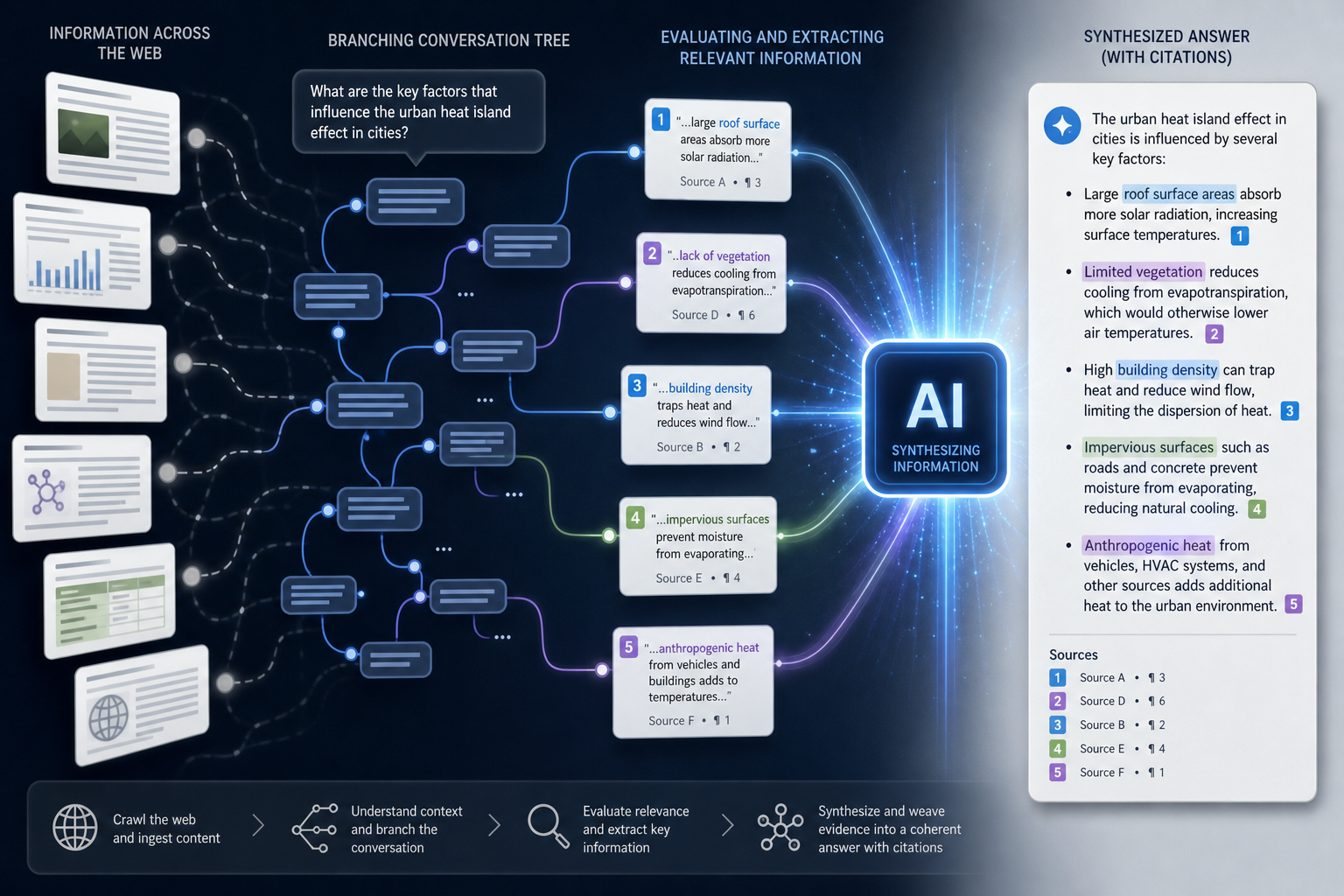
Generative Engine Optimization (GEO) is the practice of structuring and presenting content so that AI-powered answer engines, such as ChatGPT, Perplexity, Google AI Overviews, and Claude, are more likely to extract, cite, or summarize it when responding to a user's question. The goal is not a position in a ranked list. It is inclusion in the synthesized answer itself.
Traditional SEO asks: how do I rank on page one? GEO asks: when an AI assembles an answer about my category, does it pull from my content? Those are meaningfully different questions, and they require different answers. GEO is also known by related terms including Answer Engine Optimization (AEO), Large Language Model Optimization (LLMO), and AI Optimization (AIO), though they all point at the same underlying shift.
How AI engines decide what to cite
AI answer engines do not crawl and rank the way Google's traditional algorithm does. They synthesize responses from content they have indexed or retrieved, selecting passages that are authoritative, clearly structured, and directly responsive to the query. A few mechanics matter most.
First, structure. Self-contained paragraphs that open with a direct answer before adding context are far easier for a model to extract than long-form prose burying the point in paragraph four. Clear heading hierarchies, bullet points, and short paragraphs (two to three sentences) all help. Second, authority. Google's E-E-A-T framework - Experience, Expertise, Authoritativeness, Trustworthiness - carries even more weight in generative results than in conventional search. Third, recency. AI systems have a strong recency bias: roughly 50% of content cited in AI answers is less than 13 weeks old, which means freshness is not optional. Content that hasn't been updated in months is at a structural disadvantage.
Why GEO matters right now, not next year
The numbers make the urgency concrete. A July 2025 AP-NORC survey found that 60% of U.S. adults have used AI to search for information, with adoption reaching 74% among people under 30. Separately, 37% of consumers now start searches with AI instead of Google, and 41% of U.S. search volume flows through generative AI interfaces rather than standard results pages. Google's AI Overviews alone reach 2 billion monthly users across more than 200 countries.
For businesses, the practical consequence is that a buyer researching your category may never see a traditional search results page at all. They ask an AI assistant, read the synthesized answer, and act on it. If your content is not in that answer, you are invisible at the moment of highest intent - and no amount of traditional SEO fixes that gap. Understanding how Google AI Mode is reshaping search is a useful companion to this picture.
How GEO differs from SEO in practice
SEO and GEO share some foundations - quality content, credible sourcing, technical accessibility - but they diverge sharply in what they optimize for. SEO rewards comprehensive long-form pages that signal topical authority across many related queries. GEO rewards self-contained, extractable passages: a paragraph that answers one question completely, without requiring the reader (or the AI) to read the whole page.
SEO traffic is measurable in clicks. GEO value is often zero-click: the AI reads your content, synthesizes it into an answer, and the user never visits your site. That does not mean GEO has no value - being cited builds brand recognition and trust at scale - but it does mean the measurement framework is different. Rankings in traditional search persist for months or years. AI citations decay much faster, which is why continuous content production and regular updates are structural requirements of GEO, not nice-to-haves. For a broader look at how AI is changing content strategy, see AI for SEO: what it means and how to use it.
The content characteristics AI engines prefer
Certain content types are structurally more likely to be cited. Content that is specific or up-to-date in ways the model cannot answer from memory has a natural advantage: current market comparisons, frequently updated data, original research findings, firsthand experience reports, and interactive tools all fall into this category. A general explainer that restates what the model already knows is easy to ignore. A specific, dated, well-sourced answer to a precise question is much harder to pass over.
Format discipline matters too. Lead each section with the direct answer, then add context. Use one topic per heading. Keep paragraphs short. Avoid burying key facts in dense prose. These are not arbitrary style rules - they reflect how AI retrieval systems parse and extract content. A page built this way does double duty: it serves human readers clearly and gives AI engines clean, attributable passages to work with.
When an AI answers your buyer's question, you are either cited or you are absent - there is no page two.
Benefits
Cited inside AI answers, not just ranked
GEO positions your content to be extracted and attributed by AI engines, placing your brand in the answer itself rather than in a list a user may scroll past. Being cited in a synthesized AI response is a qualitatively different kind of visibility from a ranked link.
Reach high-intent buyers at the moment they decide
Users who ask AI assistants specific product or service questions are typically close to a decision. Content that appears in those AI-generated answers reaches buyers at peak intent, before they have formed a shortlist from traditional search results.
Future-proof against declining traditional click-through
As AI-generated answers absorb more of the query volume that once drove organic traffic, traditional search clicks are under structural pressure. GEO builds a visibility channel that does not depend on a user clicking through from a ranked results page.
Multilingual AI visibility without rebuilding from scratch
GEO-optimized content can be produced in multiple languages simultaneously, allowing a brand to establish AI citation presence in new markets without the years of domain authority building that traditional multilingual SEO requires. Parallel, language-specific GEO content compresses the timeline for international AI visibility.
Continuous presence as AI citation decay is real
Because roughly half of content cited in AI answers is less than 13 weeks old, a one-time content push does not sustain AI visibility. An ongoing GEO content system that researches new questions, publishes regularly, and updates existing pages is the only durable approach.
GEO in practice: four scenarios where it changes outcomes
A local physio losing leads to AI answers
A physiotherapy clinic relies on local search traffic, but a growing share of potential patients now ask an AI assistant "who's the best physio near me for lower back pain" rather than opening Google. The AI synthesizes an answer from structured local content it can find and attribute. If the clinic's website is written for human browsers rather than AI crawlers, it simply does not appear. GEO-optimized content, structured around specific conditions treated, direct answers, and clear location signals, gives the clinic a path back into those AI-generated recommendations.
A B2B software company whose buyers research via ChatGPT
A buyer at a mid-sized company is evaluating project management tools. Rather than running ten separate Google searches, they ask ChatGPT to compare the leading options for their use case. The AI draws on whatever structured, authoritative content it can retrieve. A B2B vendor whose site is built around long marketing pages rather than direct, question-answering content is unlikely to appear in that comparison. GEO requires the vendor to publish content that anticipates the exact questions buyers ask AI assistants and answers them in a format the model can extract and attribute.
A multilingual brand entering new markets
A retail brand expanding into three new European markets cannot afford to rebuild its SEO strategy from scratch in each language. But AI search adoption varies by country, and buyers in each market are asking AI assistants questions in their own language. GEO-optimized content in the local language, structured for AI retrieval, lets the brand establish AI visibility in a new market faster than traditional search authority would allow. Platforms that generate AI-optimized content in over 40 languages make this kind of parallel, multilingual GEO strategy operationally feasible.
A marketing agency tracking AI visibility for multiple clients
An agency managing search visibility for a portfolio of clients needs to know not just how each client ranks on Google, but whether they appear in AI-generated answers across ChatGPT, Perplexity, Google AI Overviews, and other engines. Without dedicated tracking, the agency has no way to report on AI citations or demonstrate the value of GEO work. Real-time AI visibility tracking across multiple engines and markets, ideally from a single dashboard, becomes a core part of the agency's reporting and strategy workflow.
What is GEO (Generative Engine Optimization)? Common questions answered
Is GEO replacing SEO, or do both still matter?
GEO does not replace SEO - the two disciplines overlap in important ways, and strong organic authority still helps AI engines trust your content. However, they optimize for different outcomes: SEO targets ranked positions in a link list, while GEO targets citations inside synthesized answers. Businesses that treat them as the same thing will underinvest in GEO and lose visibility in the channel where a growing share of high-intent queries now land.
Does my existing website need to change for GEO?
Not necessarily in terms of design or infrastructure, but the content structure often does need to change. Pages written as long-form marketing copy, burying answers in dense prose, are harder for AI engines to extract from. GEO-optimized content typically lives alongside an existing site rather than replacing it, structured specifically for AI crawlers with clear headings, short paragraphs, and direct answers at the top of each section.
How do AI engines decide which content to cite?
AI engines favor content that is authoritative, current, and directly responsive to the query. Google's E-E-A-T signals (Experience, Expertise, Authoritativeness, Trustworthiness) carry significant weight, as does recency: roughly 50% of content cited in AI answers is less than 13 weeks old. Content that answers a specific question in a self-contained, extractable paragraph, rather than requiring the model to read an entire page, is structurally more likely to be cited.
Can I track where my business appears in AI-generated answers?
Yes, though it requires dedicated tooling separate from traditional rank trackers. AI visibility tracking monitors whether your brand or content is cited across engines like ChatGPT, Perplexity, Google AI Overviews, and Gemini, across different queries and markets. Platforms like Miracly provide real-time tracking of AI citation position across multiple engines, which is the only reliable way to know whether GEO efforts are working.
How long before GEO efforts produce results?
Because AI engines have a strong recency bias, well-structured new content can appear in AI citations relatively quickly compared to the months it often takes to move in traditional search rankings. That said, citation frequency and consistency build over time as content accumulates authority signals. An ongoing content system, rather than a single batch of pages, is the approach that produces durable results.
What types of content perform best in GEO?
Content that is specific in ways the AI model cannot answer from its training data alone performs best: current market comparisons, frequently updated data, firsthand experience reports, original research, and direct answers to precise buyer questions. Generic explainers that restate widely known information are easy for a model to skip. The more specific, dated, and directly answerable your content is, the stronger its GEO signal.
Your buyers are already asking AI assistants about your category
GEO is not a future concern - 60% of U.S. adults have already used AI to search for information, and that share is growing fast. If your content is not structured for AI citation, you are invisible to a significant and high-intent slice of your market. Miracly helps businesses research the questions buyers are asking AI assistants, generate structured content engineered to be cited, and track their AI visibility in real time across multiple engines.